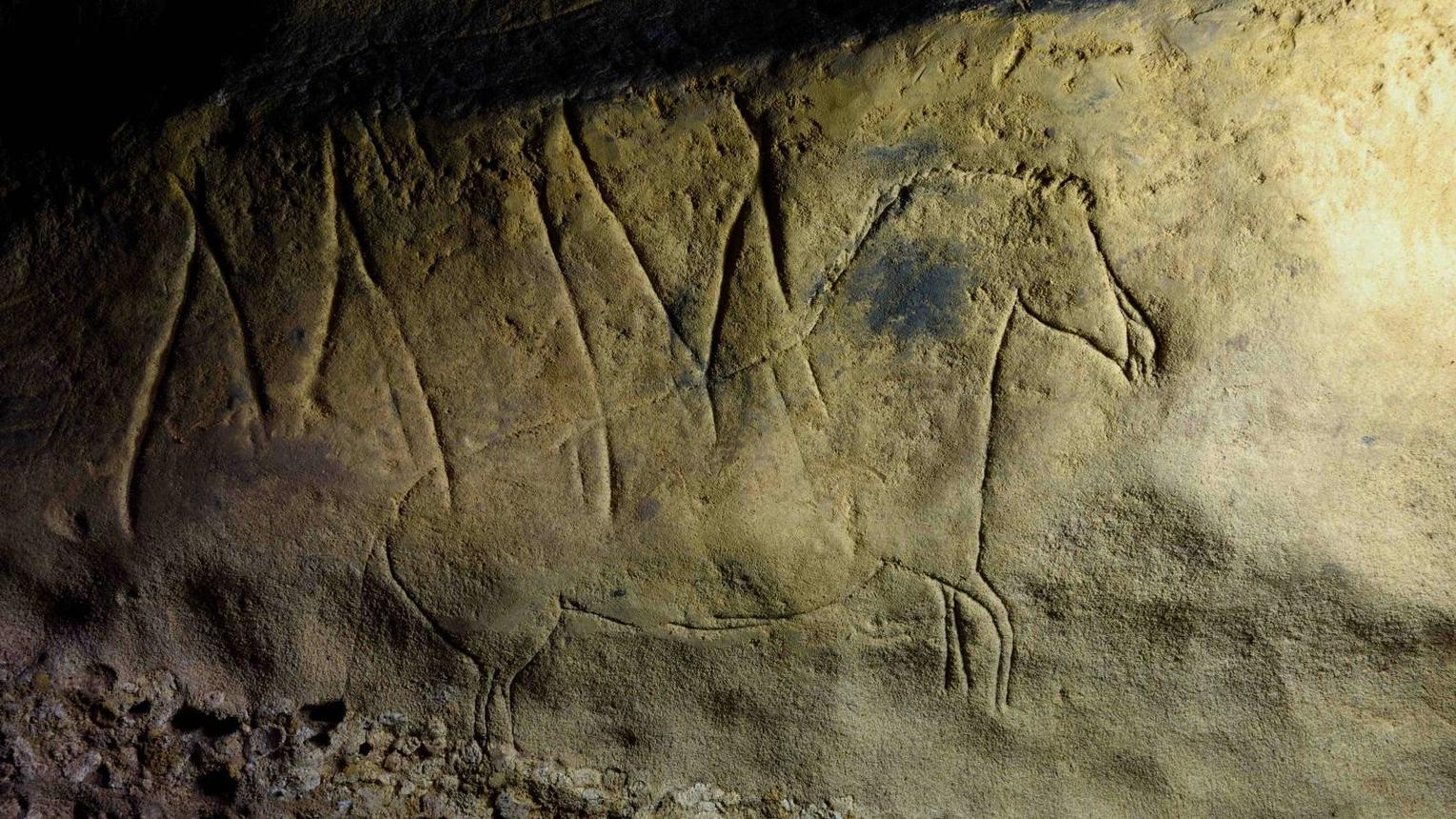
Research source: Filling gaps: The Palaeolithic rock art of the Cova de la Font Major " Antiquity, DOI: 10.15184/aqy.2026.10447
Keywords: archaeology, art history, cave art, prehistoric, Catalonia, Spain, Antiquity journal
Sources:
- Filling gaps: The Palaeolithic rock art of the Cova de la Font Major " Antiquity
- IPHES-CERCA " Cova de la Font Major challenges the traditional map of European Palaeolithic art
- Nature " The palaeo cave art that hid in plain sight
Image licensing note: Images from the 2026 Antiquity study are CC BY-NC-SA 4.0 licensed. Since DreamNoos generates ad revenue, commercial use without permission is not recommended.
Alternative: A 2022 academic paper’s Figure 3 showing an engraving from the same cave is published under CC BY 4.0:
- 2022 Antiquity article, Figure 3
- Image credit: J. M. Vergès, in Morales et al. (2022), Antiquity, CC BY 4.0
280 Prehistoric Engravings Went Unnoticed in a Spanish Cave for Decades
For generations, visitors walked through a cave in northeastern Spain without recognizing the ancient figures carved into its walls. A new archaeological study reveals a remarkable collection of animal images and abstract marks that could reshape the story of prehistoric art in the western Mediterranean.
Thousands of people have visited the Cova de la Font Major in Catalonia, Spain. Some explored its underground passages, others followed tourist routes, and many left their own names and dates scratched into the walls.
Yet among those modern marks was something far older.
In 2019, archaeologists identified prehistoric engravings in a section of the cave that had been visited for decades. A new study published in the journal Antiquity on November 5, 2026, has now documented 280 graphic motifs, including 55 animal representations.
The collection includes horses, deer, bovids, goats and an unusual depiction of a bear. It also contains numerous geometric patterns and lines whose meanings remain uncertain.
Beyond the number of engravings, the discovery challenges an established assumption about the artistic geography of prehistoric Europe: that northeastern Iberia played a relatively marginal role in the development of Upper Palaeolithic cave art.
A familiar cave with an unexpected secret
Cova de la Font Major lies beneath the town of l’Espluga de FrancolÃ, in Catalonia’s Tarragona province.
The cave system contains more than 3.5 kilometres of underground passages. Its entrance was reopened in 1957, and parts of the system later became a visitor attraction. The Gatoneres de Cal Palletes galleries, where the engravings were identified, were incorporated into an adventure route in 1993.
That history makes the discovery particularly striking.
The prehistoric images were not found in an isolated cave that had never been explored. They were on walls that people had passed for years.
The key was recognizing what the marks actually were.
During archaeological fieldwork on October 30, 2019, researcher Josep Maria Vergès Bosch noticed several unusual lines among the modern graffiti. Their characteristics suggested that they might be prehistoric engravings.
The initial observation led to a much larger investigation.
The cave walls were not an obvious place to expect such artwork. Much of the surface consists of irregular conglomerate, a type of rock made from fragments cemented together. Its uneven texture had contributed to the assumption that the cave was unsuitable for extensive prehistoric engraving.
The newly documented collection overturned that expectation.
What did the prehistoric artists leave behind?
The researchers identified 280 motifs across the cave’s engraved areas. Fifty-five represent animals, while the remainder consist mainly of non-figurative marks.
The animal images include several species associated with the prehistoric Mediterranean landscape:
- Horses and other equids.
- Deer and related cervids.
- Bovids, including animals resembling wild cattle.
- Goats and other caprines.
- A bear, a relatively unusual subject in Palaeolithic cave art.
The bear representation is especially distinctive. It shows the animal from a frontal perspective, with its ears visible and its mouth slightly open.
Many of the figures are relatively simple. Their outlines communicate the shape of an animal without providing the level of anatomical detail seen in some better-known European cave paintings.
The researchers also recorded groups of parallel lines, geometric forms, circular patterns and other compositions that are difficult to classify.
These abstract motifs are important because prehistoric art was not limited to realistic pictures of animals. Lines, repeated marks and geometric arrangements may also have carried symbolic or communicative significance.
However, their precise meanings cannot currently be established.
A different artistic tradition from the famous caves of France and northern Spain
The discovery has implications beyond the cave itself.
For a long time, discussions of European Palaeolithic art have concentrated heavily on the decorated caves of the Franco-Cantabrian region, which includes parts of modern France and northern Spain.
These sites contain some of the most celebrated examples of prehistoric imagery, including elaborate animal representations and extensive painted compositions.
By comparison, northeastern Iberia had appeared to have a much smaller record of cave art.
Before the 2019 discovery, only two cave representations attributed to the Palaeolithic were known in Catalonia, and one of those had an uncertain origin.
Font Major changes that picture.
According to the research team, the cave contains the third-largest assemblage of Palaeolithic cave art on the Mediterranean side of the Iberian Peninsula when measured by the number of animal figures, behind only Ardales and La Pileta in Andalusia.
The researchers also identify distinctive characteristics in the forms and subjects of the engravings. Their analysis suggests that the collection contributes to evidence for a Mediterranean artistic tradition with features different from those of the Franco-Cantabrian region.
That does not mean prehistoric communities in these regions were completely separate or that every difference represents a distinct cultural identity. It does suggest that the artistic record of western Europe was more geographically varied than earlier evidence indicated.
How archaeologists studied the fragile images
Recording ancient engravings is not simply a matter of photographing a wall.
Some of the lines are shallow and difficult to distinguish under direct illumination. The uneven rock surface creates additional challenges, while modern scratches can overlap with older marks.
The research team used high-resolution three-dimensional documentation to examine the engraved surfaces without relying on destructive sampling of the artwork itself.
These models make it possible to study the depth, shape and direction of individual grooves. They also allow researchers to examine how different lines relate to the natural structure of the rock.
In some cases, the artists may have incorporated natural features into their compositions.
For example, a boundary between different rock layers appears to provide a ground line beneath a horse. Natural cracks and surface irregularities may also have helped shape certain figures.
This interpretation is plausible, but it is not possible to prove the intention behind every apparent connection between an engraving and the surrounding rock.
The research also reveals how vulnerable the images are. Many engravings were made on relatively soft surfaces, and some have been crossed or affected by later graffiti.
The same conditions that made the marks relatively easy to create may also make them difficult to preserve.
How old are the engravings?
This is where the discovery requires careful interpretation.
The cave contains archaeological evidence of human presence dating to approximately 41,000 to 26,000 calibrated years before present. That evidence provides an important context for understanding the history of occupation inside the cave.
However, the engravings themselves have not yet been directly dated.
The researchers use stylistic characteristics and the archaeological context to suggest that a substantial proportion may belong to phases before the Magdalenian period, which began around 19,000 years ago.
This is a form of archaeological interpretation, not a direct measurement of the age of each carved line.
It is therefore inaccurate to state that all 280 motifs have been scientifically confirmed to be exactly 26,000 years old.
The collection may include works from different periods, and the authors do not rule out the possibility that some engravings were produced during the Magdalenian or later.
This distinction matters. Archaeologists often reconstruct the age of prehistoric art by combining several kinds of evidence, and the strength of a chronological conclusion depends on how closely that evidence is connected to the artwork itself.
Further research will be needed to refine the chronology.
What the discovery tells us about missing archaeological evidence
Perhaps the most interesting lesson from Font Major is not simply that prehistoric people created more art than previously recognized in Catalonia.
It is that the archaeological record can be incomplete even in places that have been explored extensively.
For decades, researchers and visitors had access to the cave. Yet the engraved figures remained unidentified, partly because their shallow lines were difficult to see and partly because the cave’s unusual rock surfaces were not expected to preserve substantial Palaeolithic art.
The discovery suggests that apparent gaps in the distribution of prehistoric art may sometimes reflect the limitations of research methods, visibility and preservation rather than a genuine absence of artistic activity.
That possibility has consequences for how archaeologists investigate other caves.
A site should not necessarily be dismissed because its walls appear unsuitable or because previous visitors have already explored its accessible galleries.
Modern lighting techniques, detailed surface recording and three-dimensional modelling may reveal evidence that earlier investigations overlooked.
Protecting a fragile record of human creativity
The Cova de la Font Major collection is now an important reference point for studying prehistoric artistic expression in the western Mediterranean.
Its significance lies in both its scale and its diversity. The animal figures provide evidence of the subjects prehistoric artists chose to represent, while the abstract motifs raise questions about forms of visual expression that are not yet fully understood.
The discovery also highlights a conservation challenge.
The engraved surfaces are fragile, and the presence of modern graffiti demonstrates how easily later human activity can interfere with archaeological evidence. Continued documentation and protection will be essential if researchers are to study the collection without causing further damage.
The cave does not offer a complete explanation of what its artists believed or why they chose particular images. It cannot tell us exactly how these communities organized their lives or how they understood the world around them.
But it adds an important piece to the picture.
For generations, people walked past these walls without recognizing the significance of the lines carved into them. Today, those marks are helping archaeologists reconsider where prehistoric artistic traditions developed and how much of the human past may still be waiting to be recognized.