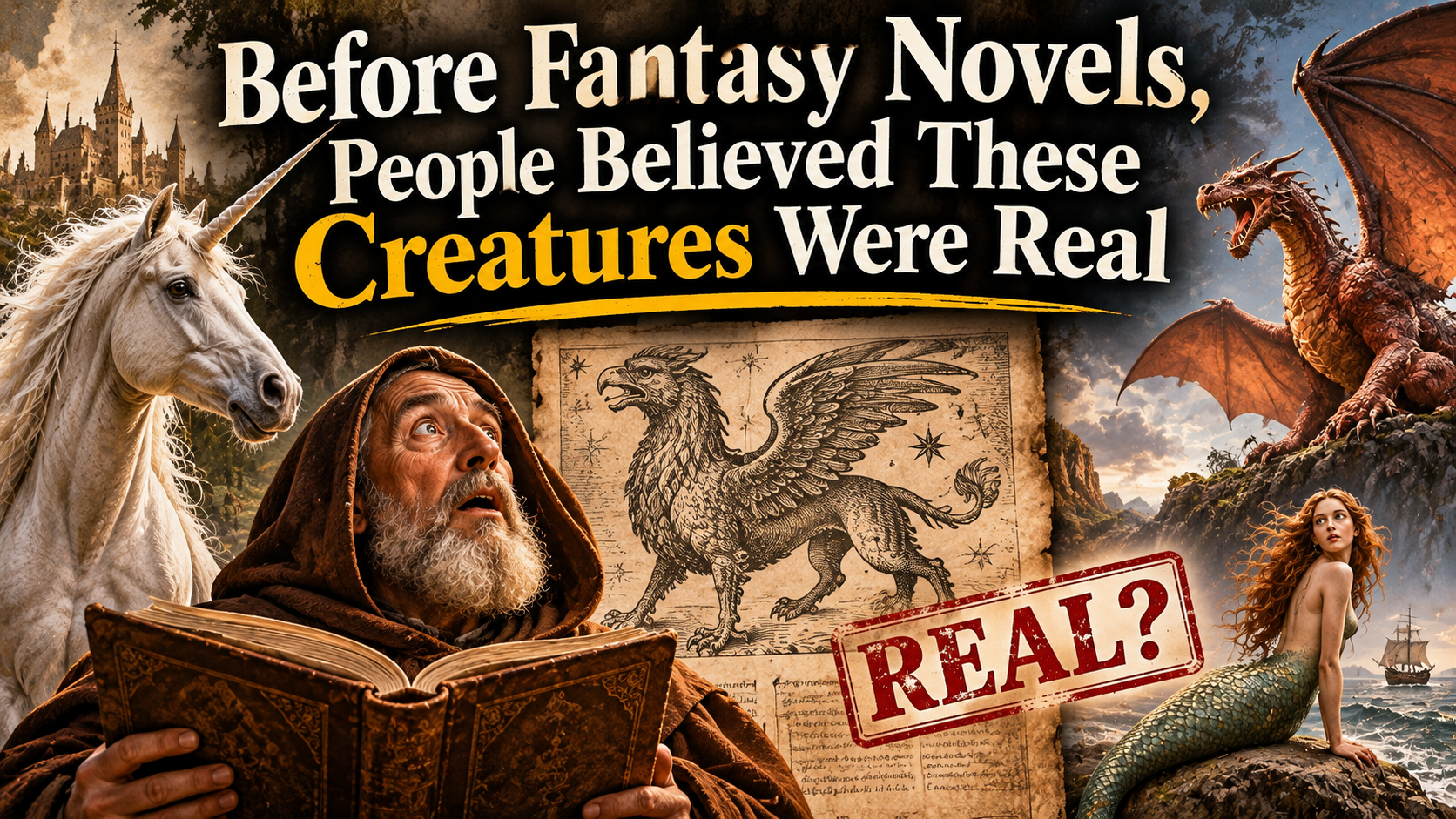
Before Fantasy Novels, People Believed These Creatures Were Real
Today, dragons, unicorns and mermaids belong to fantasy novels, films and video games. We recognize them as products of imagination, symbols from ancient stories or characters from fictional worlds.
But for much of human history, the boundary between the natural world and the supernatural was not so clear.
Travelers returned from distant lands with extraordinary accounts. Sailors described strange beings in the sea. Scholars copied stories about animals they had never seen. Churches and royal collections displayed objects believed to belong to legendary creatures.
Some people did not simply enjoy these stories. They accepted them as descriptions of the living world.
The fascinating question is not just why people believed in mythical creatures. It is how those beliefs developed, what real discoveries may have influenced them, and why certain legends survived for centuries.
Long before fantasy became a literary genre, the world was already full of fantastic beasts.
1. The Unicorn: An Animal People Thought Could Be Found
The unicorn is perhaps the clearest example of a mythical creature once treated as a real animal.
In medieval European imagination, it was usually described as a horse-like creature with a single horn projecting from its forehead. It was associated with purity, power and healing. Some accounts claimed that its horn could neutralize poison or protect people from disease.
These beliefs were not confined to children’s stories.
Unicorn horns became valuable objects in European collections. Churches and wealthy households sometimes displayed long, spiraled horns that were believed to have come from unicorns. Some were treated as precious relics, while others were associated with supposed medicinal properties.
There was, however, a real animal behind many of these objects: the narwhal.
The narwhal is an Arctic whale whose males commonly have a long, spiraled tusk extending from the upper jaw. Before modern zoology made the animal familiar to Europeans, its tusk could easily become an extraordinary object in the hands of traders.
A narwhal tusk could be presented as a unicorn horn, and its rarity helped maintain its reputation.
The American Museum of Natural History documents how unicorn traditions appeared in different parts of the world, while the Rijksmuseum describes how narwhal tusks were kept in European churches as supposed unicorn horns.
The real story is more interesting than a simple case of mistaken identity. It shows how rare objects, commercial interests, religious beliefs and stories from distant places could reinforce one another.
People were not necessarily inventing everything they described. Sometimes they were interpreting unfamiliar evidence through the beliefs of their time.
2. Dragons: The Monster That Appeared Across Civilizations
Dragons seem almost universal in mythology, but they do not represent exactly the same idea everywhere.
In many European stories, dragons were dangerous creatures associated with destruction, evil and the heroic challenge of a saint or warrior. In several East Asian traditions, dragons were connected with water, rain, prosperity and authority.
That difference matters.
A dragon was not simply a monster copied from one culture to another. It developed through different histories, religious traditions and symbolic systems.
In medieval Europe, dragons also appeared in books that attempted to describe the natural world.
These books were known as bestiaries. They combined descriptions of real animals with stories about extraordinary creatures, often adding moral or religious interpretations. A lion might represent courage, while a dragon could symbolize evil or temptation.
The creatures were therefore presented as more than entertaining illustrations. They could be understood as part of a meaningful account of creation.
Could dinosaur fossils have inspired dragon legends?
It is an appealing possibility, but it should not be presented as an established explanation. There is no general historical proof that medieval Europeans discovered dinosaur fossils and created dragon stories from them.
Other influences are easier to document. Large snakes, crocodiles, unfamiliar reptiles, travelers’ reports and inherited stories could all contribute to descriptions of dragon-like animals.
A study by Phil Senter and colleagues examined how descriptions of dragons evolved in historical natural-history literature. It shows how accounts of real snakes gradually accumulated extraordinary characteristics over time.
The result was a creature that became increasingly difficult to separate from legend.
3. Mermaids: When Sailors Thought They Saw Something Human
For centuries, sailors reported encounters with mysterious beings in the water.
Some described beautiful women with fish tails. Others spoke of strange figures sitting on rocks or disappearing beneath the waves.
Mermaid stories appeared in different cultures, although their appearance and meaning varied considerably.
Why would experienced sailors report seeing something so extraordinary?
One possible explanation involves marine mammals.
Manatees and dugongs spend time near the water’s surface and can sometimes be seen with their bodies partly exposed. From a distance, in poor visibility or after a long voyage, an unfamiliar observer might interpret their movements in unexpected ways.
This explanation is often repeated in discussions of mermaid sightings. It is plausible in some cases, but it cannot explain every mermaid tradition or historical account.
The stories also existed within a broader cultural imagination. The sea was a dangerous and poorly understood environment. Sailors encountered unfamiliar animals, changing weather and places that were difficult to map.
A mysterious sighting could become a story, and a story could become part of a shared tradition.
Historical records also reveal that mermaids were not always treated as harmless fantasies. Some early modern scholars collected supposed evidence, while traveling exhibitions later presented fabricated or misleading objects as proof.
The famous Feejee Mermaid exhibited in the nineteenth century is one example of how curiosity about the extraordinary could be turned into commercial entertainment.
Mermaid stories reveal something important about human perception: when people encounter something they cannot easily explain, familiar cultural stories can shape what they believe they have seen.
4. The Griffin: A Creature That May Have Been Inspired by Fossils
The griffin is usually depicted with the body of a lion and the head and wings of an eagle.
It combines two animals that represented power in different ways: the lion as a dominant land predator and the eagle as a powerful bird of prey.
The creature appeared in ancient art and later became a familiar figure in European heraldry, decoration and medieval storytelling.
One intriguing theory connects griffin legends with dinosaur fossils found in Central Asia.
The idea focuses on Protoceratops, a dinosaur with a beaked skull and four-legged body. Its fossil remains were found in regions associated with ancient trade routes. Some researchers have suggested that people encountering exposed fossils might have interpreted them as the remains of unusual creatures.
The resemblance between a Protoceratops skull and the beaked head of a griffin has made this theory particularly memorable.
But there is an important distinction between an interesting possibility and proven history.
There is no conclusive evidence that the discovery of Protoceratops fossils directly created the griffin myth. The theory offers a possible explanation for how unusual fossils might have influenced stories, rather than a confirmed origin.
That uncertainty does not make the idea less fascinating. It reminds us that ancient people lived in landscapes where the remains of unfamiliar animals could emerge from the ground without any modern scientific explanation.
5. Medieval Bestiaries: Books Where Real and Imaginary Animals Shared the Same Pages
Imagine opening an encyclopedia in which lions, elephants, dragons, unicorns and creatures with extraordinary abilities appear side by side.
For medieval readers, this was not necessarily unusual.
Bestiaries were illustrated collections of animals and animal stories. They drew on earlier classical and religious traditions, combining natural descriptions with moral lessons.
A creature could be included because someone believed it existed, because an earlier author had described it, or because its symbolic meaning was considered important.
The British Library and the J. Paul Getty Museum have explored these extraordinary books and the creatures they contain.
Some illustrations are especially revealing. The bonnacon, for example, was described as a bull-like animal whose unusual defense involved spraying its pursuers with burning dung.
To modern readers, this sounds like a comic fantasy creature. In a medieval bestiary, however, it could appear alongside familiar animals in a book that presented itself as a guide to the natural world.
These manuscripts were not modern scientific textbooks. Their purpose was different. They preserved inherited knowledge, religious interpretation, moral instruction and stories about the world.
They also reveal how people organized information before modern scientific methods became widespread.
The distinction between an observed animal and a legendary one was not always as clear as it is today.
6. Why Did People Believe These Creatures Existed?
It is tempting to assume that people in the past simply lacked intelligence or curiosity. That explanation misses the point.
They were trying to understand a world in which information traveled slowly and direct observation was limited.
A traveler might describe an animal from a distant region. A writer could repeat that description without ever seeing the creature. Another author might copy the account, add details and give it a moral meaning.
After enough repetitions, a story could acquire the authority of established knowledge.
Several factors helped these beliefs survive:
Limited access to distant places. Most people could not personally verify reports from remote mountains, deserts or oceans.
The authority of written sources. A description copied into respected books could appear credible, even if its original source was uncertain.
Rare and unfamiliar objects. Fossils, unusual animal remains and imported objects could be interpreted through existing beliefs.
Religious and symbolic meaning. Creatures often represented virtues, dangers or spiritual ideas, making their stories culturally important.
Commercial incentives. Rare objects and supposed wonders could attract collectors, wealthy patrons and paying audiences.
These factors did not operate independently. They often reinforced one another, allowing extraordinary stories to remain convincing long after their origins had been forgotten.
7. The Line Between Myth and Discovery Is Not Always Simple
Modern science has transformed our understanding of the natural world. We can examine fossils, compare DNA, study animal behavior and explore places that were once difficult to reach.
Yet the history of mythical creatures is not simply a story of old beliefs being replaced by facts.
Some legendary descriptions were influenced by real animals. Others may have developed from misunderstandings, symbolic traditions or deliberate inventions. In many cases, we cannot identify a single origin.
The unicorn’s association with narwhal tusks is supported by historical collections. Mermaid sightings may sometimes have involved marine mammals, but that cannot explain every tradition. The proposed connection between griffins and dinosaur fossils remains debated.
And dragons continue to remind us that similar creatures can carry very different meanings across cultures.
The most useful question is not whether every mythical creature had a real counterpart. It is how people made sense of unfamiliar evidence and transformed it into stories that lasted.
The Creatures Disappeared From Natural History, but Not From Human Imagination
Today, we no longer expect to find unicorns in a forest or dragons beyond a mountain range.
But these creatures have not vanished.
They live in books, films, museums, architecture, national symbols and family stories. Their images continue to shape how we imagine distant places and forgotten worlds.
Perhaps that is why they remain so powerful.
Each creature carries more than a description of an impossible animal. It preserves a fragment of the world that created it: what people feared, what they admired, what they misunderstood and what they hoped might exist beyond the edge of their known world.
Before fantasy novels, people did not need fictional universes to encounter extraordinary creatures.
They already believed the real world was full of them.
Sources and Further Reading
- American Museum of Natural History – Unicorn
- Rijksmuseum – Mythical Creatures
- The J. Paul Getty Museum – What Did People Believe about Animals in the Middle Ages?
- The British Library – Care of Magical Creatures
- Phil Senter et al. – Snake to Monster: The Evolution of the Dragon in Natural History Literature
- American Museum of Natural History – Mythic Creatures: Dragons, Unicorns & Mermaids
Editorial note: Historical theories about the origins of legendary creatures are not all equally established. This article distinguishes documented historical objects and beliefs from proposed explanations.