
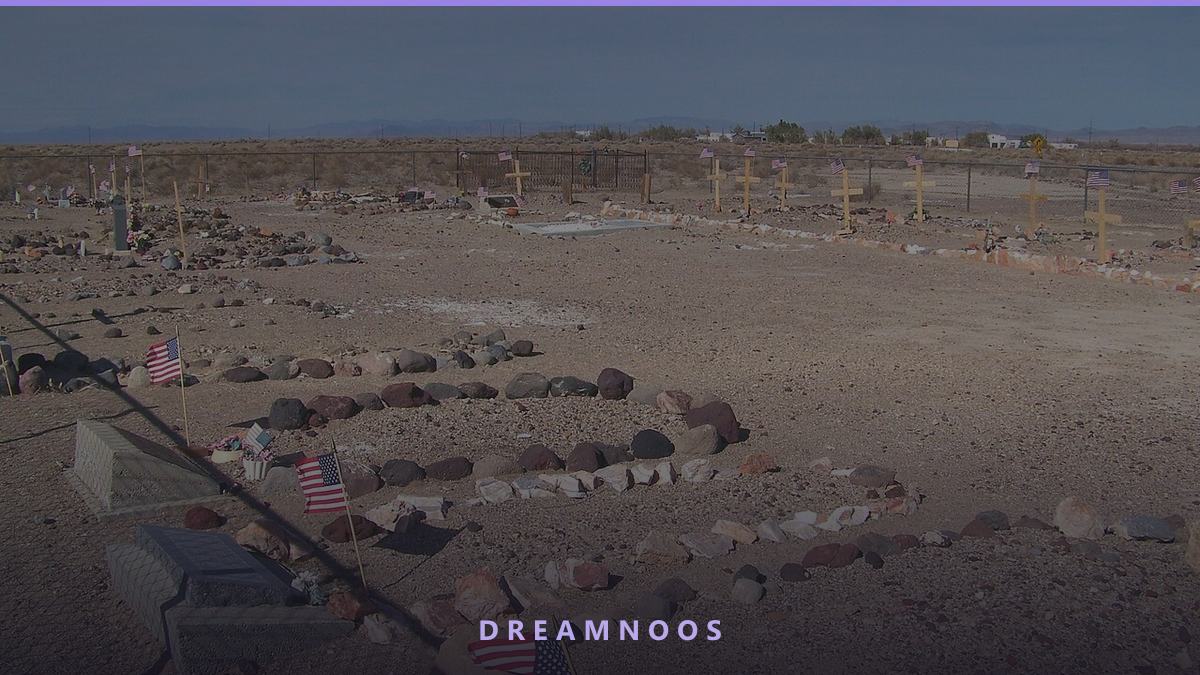
What a cemetery dream means
A cemetery is not only “death place.” It is memory architecture: rows, names, dates, rituals. Cemetery dreams usually appear when you are negotiating what must be kept and what must be released—grief, legacy, guilt about moving on, or fear that forgetting equals betrayal.
Dream mechanics focus
- Path layout: orderly rows can mean structured grief; maze-like paths can mean disorientation in mourning.
- Lighting: sun on marble vs fog—clarity vs numb uncertainty.
- Sound: wind, distant traffic, silence—whether the world continues while you stand still.
- Touch: cold stone vs warm flowers—distance vs living care.
Classical readings of cemetery dreams
Classical place symbolism treats burial grounds as thresholds: where the living speak to the dead, where vows are renewed or guilt is staged. Modern dreamers may import horror tropes; interpretive ethics separate sacred grief from sensational fear unless the dream insists on horror.
Cemetery symbolism
- Walking alone: private integration of loss or identity shift.
- Guided tour: inherited narratives—what family tells you about who you are.
- Name you recognize: specific relationship work, not generic “death anxiety.”
- Empty cemetery: fear of being forgotten; or relief from pressure of legacy.
The psychology of cemetery dreams
Anxiety and illness as thematic tags can enter as hypochondria channels or aging awareness—not predictions. Often the cemetery is where the psyche stores what you are afraid to feel while functional.
High-intent variants (micro-intent map)
- Child in cemetery: protective grief; fear of exposing innocence to endings.
- Wedding next to cemetery: joy adjacent to loss—ambivalence about commitment costs.
- Digging (without horror glorification): research into truth; family secrets—interpret without encouraging unsafe behavior.
- Locked cemetery gate: exclusion from mourning community; shame.
- Cleaning a stranger’s stone: empathy overflow; boundary question.
- Crowded funeral you miss: regret and social scheduling guilt.
How context changes a cemetery dream
- War memorial section: collective grief vs personal grief entangled.
- Pet burial corner: smaller losses that society minimizes but you feel fully.
Non-obvious interpretive insights
- GPS failing in cemetery can mean narrative disorientation—who am I without this loss story?
- Taking a photo can map to fear of forgetting faces—memory as duty.
Observed recurring patterns
- Frequently reported around anniversaries, probate tasks, or migration away from family graves.
- Recurring night-cemetery dreams sometimes track depression onset—not diagnostic, but worth gentle real-world check-ins.
- Some dreamers report spikes after visiting a real cemetery—normal consolidation dreams.
Common co-occurring symbols
- Cemetery + road: life continues beyond the gate—movement vs mourning tension.
- Cemetery + rain: washing grief; softened defenses.
- Cemetery + church: ritual container for meaning—belief systems supporting grief.
Interpretive contradictions
- Peace in a cemetery is not always denial; sometimes it is integrated mourning.
- Fear in a cemetery is not always pathology; sometimes it is honest confrontation with endings.
Positive/negative interpretation conditions
Positive lanes favor flowers, cleaning, calm weather, companionship, meaningful names. Cautionary lanes favor being pulled into graves, being lost alone, desecration themes—process with care; seek support if intrusive.
Source-anchored notes
Burial-ground symbolism spans cultures with different rites; avoid collapsing all traditions into one “spiritual meaning.”
Real-world interpretation boundary
If you are actively grieving, dreams are one thread; human connection and professional grief support are others.
Entity psychology — cemetery
Core symbol — cemetery anchors the dream’s central metaphor. Context first — Setting and emotion around cemetery beat generic glossaries. Role in scene — Witness, victim, tool, or background cemetery changes weight. Waking link — Recent news, media, or memory featuring cemetery primes fairly. Agency — Whether you act on cemetery or watch passively. Repeat visits — Same cemetery returning marks unresolved theme—not omen.
Traits to track: instinct, wild mirror, unclassified creature.
What cemetery represents in dreams
- Core cemetery symbol — Your waking associations to cemetery anchor the read before any glossary.
- Setting layer — Home, travel, work, or nature calibrates tone and scale.
- Your role — Witness, cause, rescuer, or fugitive shifts agency.
- Emotion on waking — Fear, grief, relief, or shame tilts integration vs avoidance.
- Vs cluster links — Compare related hub pages in your graph—not interchangeable symbols.
Extended psychological read
Psychologically, Cemetery in a Dream maps emotion about cemetery under presence force—witness vs actor, familiar vs stranger. One honest waking link beats catalog prophecy.
Cemetery dreams across cultures and traditions
Classical dream manuals emphasize context over isolated symbols; combine tradition as metaphor library with waking facts you already know.
More cemetery dream scenarios
Absurd cemetery detail. Rule-break may flag waking desire for change.
Someone else holds cemetery. Compare their role to yours.
Familiar cemetery, calm scene. Personal memory over archetype alone.
Night after media with cemetery. Priming fair—name source.
Calm after fear of cemetery. Regulation arc in one dream.
You search for cemetery. Active missing theme.
You act on cemetery. Agency tilts repair vs avoidance.
Return to same cemetery next night. Repeat motif—not prophecy.
Cemetery changes form. Symbol shift mid-dream—track sequence.
You explain dream to someone. Integration—listener reaction matters.
Negative signals vs positive signals
| Signal type | Scene cue | Read |
|---|---|---|
| Strain | Panic, no action | Anxiety loop on cemetery |
| Strain | Stranger cemetery, no context | Archetype overload |
| Repair | Care or rescue acted | Agency after {attr} |
| Repair | Calm after naming feeling | Integration arc |
How to read your cemetery dream
- Opening image — First thing you remember about cemetery.
- Conflict point — When {attr} became visible on cemetery.
- Support or isolation — Help present or alone with cemetery.
- Body signal — Where you felt it waking (chest, gut, throat).
- Fair read — Symbol first; check facts only if worry persists.
More cemetery dream questions
Vs similar symbols? Cemetery psychology differs from swap-in entities—use cluster contrasts.
Childhood memory of cemetery? Personal history outweighs generic omen lists.
Nightmare vs curious dream? Waking emotion calibrates threat, not dictionary alone.
Recurring cemetery? Track one waking theme per week—pattern over single night.
What your cemetery dream is telling you
Name one role you played, one emotion on waking, and one waking link to cemetery. Revisit cluster pages when cemetery repeats—integration beats prophecy spiral.
Snippet-oriented recap
Cemetery dreams map instinct, wild mirror, unclassified creature through scene context. Link related hub entries—not fixed omen gloss alone.
Share Your Dream Experience
Had a similar dream? Share your experience or ask a question — comments appear after moderation.
No comments yet. Be the first to share your experience.