Research source: Human land use drives microplastic abundance in terrestrial wildlife " Nature, November 11, 2026
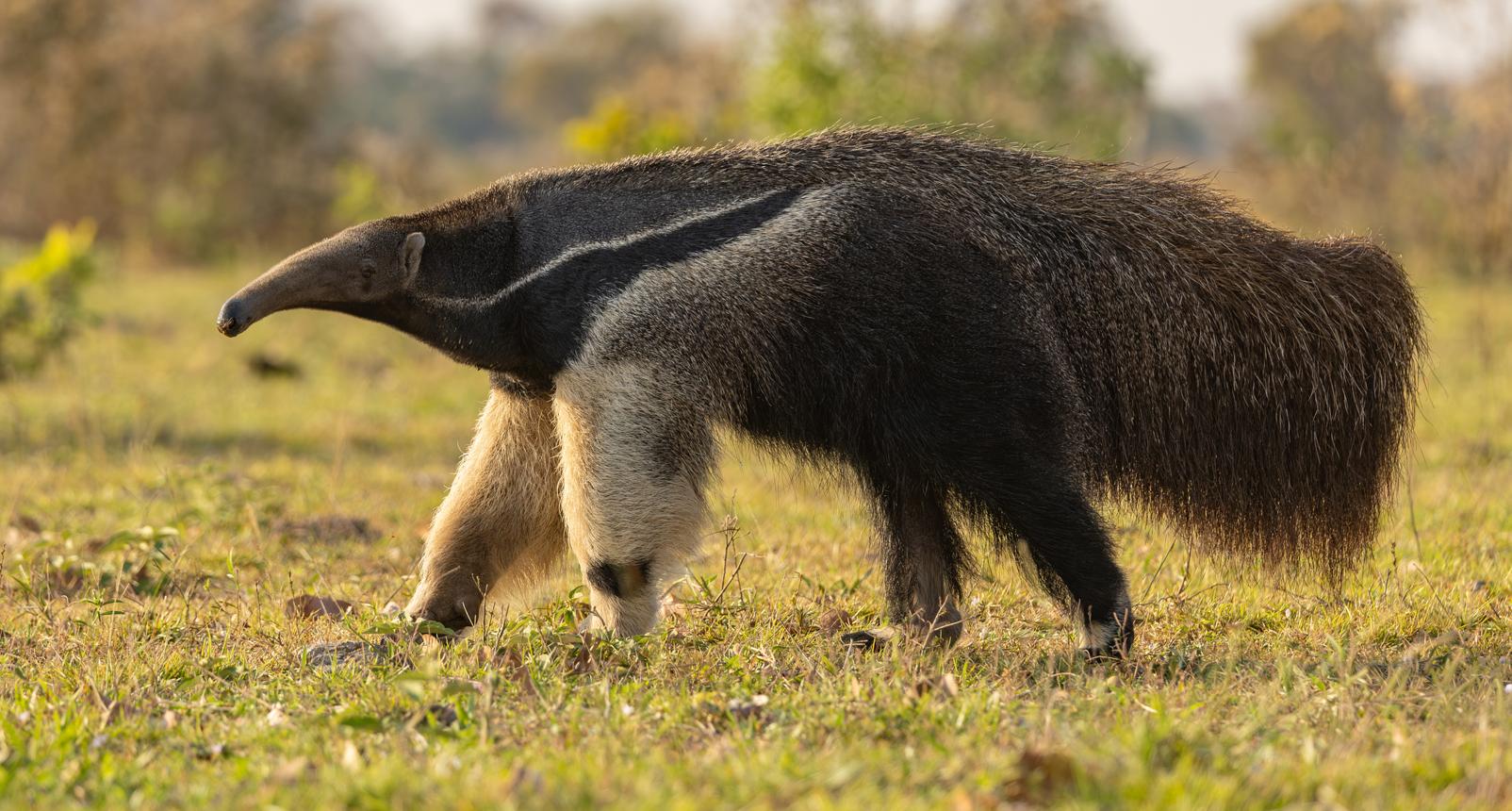
Image credit: Giant Anteater " Wikimedia Commons, photo by dany13, CC BY 2.0
Keywords: environment, wildlife, microplastics, pollution, Brazil, tapir, giant anteater, conservation
Sources:
- Human land use drives microplastic abundance in terrestrial wildlife " Nature
- Wikimedia Commons " Giant Anteater, CC BY 2.0
Editorial note: This article does not claim microplastics made the animals sick. The research shows plastic particles in blood circulation and a relationship with exposure to human activity; long-term health effects remain unexplained.
Microplastics Found in Wild Animals Living Far From Cities
Scientists detected plastic particles in the blood of Brazilian giant anteaters and lowland tapirs, including animals living in seemingly undisturbed habitats. The findings reveal how pollution can travel beyond the places where it originates.
A giant anteater can spend much of its life moving through grasslands, wetlands and forests far from major cities. A lowland tapir may travel through dense vegetation, following paths that have existed long before nearby roads or settlements.
These animals are not usually associated with the everyday sources of plastic pollution. They do not live in urban drainage systems or industrial districts, and they are unlikely to encounter the same concentrations of discarded packaging found around human settlements.
Yet a new study suggests that even these relatively remote environments are not beyond the reach of plastic contamination.
Research published in Nature on November 11, 2026, found microplastics in the blood of wild giant anteaters and lowland tapirs in Brazil. The particles were detected in animals living across the Amazon, Cerrado and Pantanal regions, including individuals whose movements took them far from human infrastructure.
The discovery adds an important dimension to the growing understanding of plastic pollution: the problem is not confined to rivers, oceans and heavily populated landscapes. It can also reach the bodies of terrestrial wildlife.
Researchers followed animals beyond the laboratory
The study, titled Human land use drives microplastic abundance in terrestrial wildlife, brought together wildlife tracking and laboratory analysis.
Researchers collected blood samples from 47 animals: 26 lowland tapirs (Tapirus terrestris) and 21 giant anteaters (Myrmecophaga tridactyla).
The animals came from three contrasting Brazilian environments:
- The Amazon, including areas affected by agricultural expansion.
- The Cerrado, a vast tropical savanna landscape.
- The Pantanal, one of the world’s largest tropical wetlands.
Blood samples were collected between February 2021 and November 2022.
The team also used GPS tracking data to understand where individual animals travelled and how frequently their movements brought them into contact with human-modified landscapes.
This combination was important. Measuring plastic particles in an animal’s blood can reveal internal exposure, but it does not automatically explain where that exposure occurred.
By connecting laboratory results with movement data, the researchers could investigate whether animals living closer to roads, settlements, development and waste-management facilities carried different levels of contamination.
Plastic particles appeared in almost every animal
The results were striking.
Researchers identified 2,815 microplastic particles among the analysed particles in the blood samples. Microplastics were detected in 43 of the 47 animals.
Across all samples, the average concentration was approximately 73.8 particles per millilitre of blood.
Lowland tapirs had an average concentration of 98.9 particles per millilitre, while giant anteaters averaged 42.8 particles per millilitre.
However, the researchers did not find a statistically significant difference between the two species’ overall concentrations.
The results also varied substantially between individual animals. Some carried relatively low concentrations, while others had much higher levels.
This variation is important because it suggests that exposure is not uniform, even among animals belonging to the same species.
The researchers identified particles from several different plastic polymers, showing that wildlife can encounter a mixture of materials rather than a single type of plastic.
The study used confocal Raman spectroscopy to identify particles larger than one micrometre. This technique helps distinguish polymer materials by analysing how they interact with light.
Human activity leaves a measurable environmental footprint
One of the study’s most important findings was the relationship between microplastic concentrations and the animals’ exposure to human activity.
Individuals living in areas with a greater human footprint generally carried higher microplastic burdens.
Animals whose movements brought them closer to development and waste-management infrastructure also tended to have higher concentrations.
This relationship provides evidence that the expansion of human activity into natural landscapes can influence the exposure of terrestrial wildlife to plastic pollution.
But the findings also revealed something more difficult to explain.
Microplastics were detected in animals living in seemingly pristine habitats, including individuals located more than 100 kilometres from waste-management facilities and around 65 kilometres from human infrastructure.
These distances demonstrate that direct contact with towns, roads or waste facilities is not the only possible route of exposure.
Plastic particles can move through several environmental pathways.
Wind can carry small particles over considerable distances before depositing them on vegetation or soil. Rainfall can transport particles into streams and rivers. Flooding can redistribute material across wetlands and floodplains.
Once plastic enters an ecosystem, it can move through soil, water, plants and food webs.
The researchers suggest that atmospheric and waterborne transport may help explain why animals living far from obvious pollution sources were still exposed.
Why the Amazon and Pantanal findings matter
Brazil contains some of the most important terrestrial ecosystems on Earth.
The Amazon rainforest is home to extraordinary biodiversity, while the Cerrado supports a distinctive mixture of grasslands, woodland and savanna habitats. The Pantanal is internationally recognized for its wetlands and rich wildlife communities.
These environments are often discussed in terms of deforestation, habitat fragmentation, agricultural expansion and climate change.
Plastic contamination adds another layer to the environmental pressures affecting them.
The study does not suggest that all three ecosystems are equally contaminated or that every species faces the same exposure. Its findings instead show that the relationship between wildlife and plastic pollution depends partly on how individual animals use their habitats.
An animal that regularly moves near agricultural areas, roads or settlements may encounter different pollution sources from one that remains in a relatively undisturbed region.
This makes animal movement an important part of environmental research.
A protected area may look remote on a map, but the animals living inside it are not necessarily isolated from pollutants transported across regional boundaries.
Does finding microplastics in blood mean the animals are becoming sick?
This is one of the most important questions raised by the research, but it is also where caution is necessary.
The study establishes that microplastic particles were present in the blood of many of the sampled animals. It also identifies relationships between contamination levels and exposure to human-modified environments.
It does not establish that the detected particles caused a particular disease, reduced reproductive success or shortened the animals’ lives.
Those questions require different kinds of research.
Scientists would need to investigate how particles interact with animal tissues, whether they trigger inflammatory responses, how long they remain in the body and whether exposure affects health over time.
Long-term monitoring would also be needed to determine whether individuals with higher concentrations experience different survival or reproductive outcomes.
The study involved 47 animals from two species. Its results are valuable, but they should not be treated as a complete measurement of microplastic exposure across all Brazilian wildlife.
It is also important to distinguish microplastics from nanoplastics. The study’s analytical method targeted particles larger than one micrometre, so it does not provide a complete picture of every smaller plastic particle that may be present in the environment or in animal tissues.
The problem may be larger than the places where plastic is discarded
For years, much of the public discussion about plastic pollution has focused on visible waste: bottles on beaches, packaging in rivers and discarded fishing equipment in the ocean.
Those problems remain serious, but the new findings highlight a less visible dimension.
Plastic pollution can travel far beyond the locations where products are manufactured, used or discarded. Small particles can move through air and water, making remote habitats part of a much larger environmental system.
This means that protecting wildlife requires more than reducing visible waste inside national parks and protected areas.
Better waste management, reduced plastic leakage, monitoring of agricultural landscapes and improved understanding of long-distance pollution pathways could all contribute to reducing environmental exposure.
The study also demonstrates the value of combining wildlife conservation with environmental chemistry. GPS tracking can reveal where animals encounter human activity, while laboratory analysis can show whether those encounters are associated with measurable contamination.
Together, these approaches offer a more detailed picture of how human land use affects wildlife.
A warning from animals that live beyond the city
The giant anteater and lowland tapir are very different from people in their diets, habitats and daily behaviour. Yet the presence of microplastics in their blood reveals a shared environmental reality.
The boundaries between developed and natural landscapes are not barriers to pollution.
Some particles can travel through the atmosphere, move with water and enter habitats that appear untouched. Animals can then encounter those particles through their surroundings and food.
The researchers have not yet established what these findings mean for the long-term health of the animals. That remains an important question for future studies.
But the discovery changes the way scientists can approach terrestrial plastic pollution.
The challenge is no longer simply to identify where plastic waste accumulates. It is also to understand how that pollution moves through entire landscapes and reaches the wildlife living within them.
Even far from the nearest city, the environmental footprint of human activity may be present in places where it is almost impossible to see.