Research source: Nature, DOI: 10.1038/s41586-026-11213-z
Image credit: NASA, ESA, CSA, STScI, W. Balmer (JHU), L. Pueyo (STScI), M. Perrin (STScI), CC BY 4.0
Keywords: astronomy, space, exoplanet, James Webb, imaging, direct imaging, planet detection
Sources:
- Imaging exoplanets below the telescope stability limit " Nature
- Hidden planet emerges from the glare " Northwestern University
- 51 Eri b " ESA/Webb
James Webb Reveals a Hidden Exoplanet With a New Imaging Method
An innovative image-processing technique has helped astronomers detect a distant giant planet that conventional analysis struggled to reveal, offering a new way to search for worlds beyond our solar system.
For decades, astronomers have faced a frustrating problem when trying to photograph planets around other stars: the planets are usually overwhelmed by the brilliance of the stars they orbit.
A star can outshine its planetary companion by an enormous margin. Even when a telescope is powerful enough to collect the planet’s faint light, small changes in the instrument can make that signal difficult to separate from the surrounding glare.
A new study published in Nature on November 4, 2026, describes a method that could make this challenge easier to overcome. Researchers used a physics-based image-processing framework called FLIP to improve the James Webb Space Telescope’s observations of distant planetary systems.
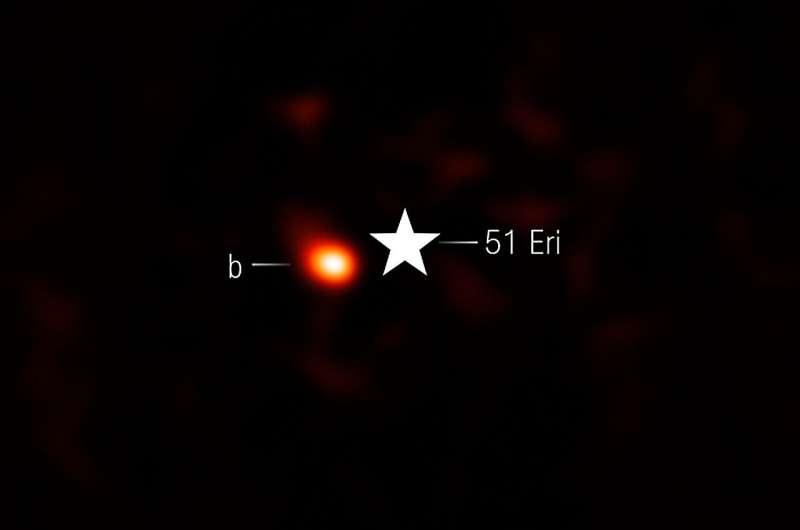
The result was more than a technical improvement. The method revealed a signal from 51 Eridani b at a wavelength where earlier analysis had failed to detect it.
The work offers a promising direction for astronomers trying to study planets that are currently difficult to observe directly.
Why photographing another planet is so difficult
Finding an exoplanet and photographing one are two very different tasks.
Astronomers have identified thousands of planets outside our solar system using methods such as the transit technique, which measures the slight dimming of a star as a planet passes in front of it, and radial velocity measurements, which detect the gravitational influence of an orbiting planet on its star.
Direct imaging is more demanding. It requires a telescope to distinguish the planet’s own light from the much brighter light of its host star.
The difference can be extreme. Young giant planets, despite being relatively bright by planetary standards, can still be around 100,000 times fainter than their host stars in near-infrared observations.
Telescopes use instruments called coronagraphs to block or suppress much of the star’s light. But blocking the star does not eliminate every problem. Optical imperfections, tiny pointing errors and temperature-related changes can alter the pattern of residual starlight recorded by the detector.
That remaining light can hide a planet or make its signal difficult to distinguish from instrumental noise.
A different way to remove the star’s glare
The research team developed FLIP, short for Physics-based Learning for Imaging Planets.
Rather than relying primarily on reference images to estimate and subtract starlight, FLIP builds a model of how light travels through the telescope’s optical system. It then adjusts that model to better match the actual observation.
The distinction matters.
Traditional approaches often compare a science image with reference observations taken at another time or under different conditions. But the telescope may not be in precisely the same state during both observations. Small changes can leave behind unwanted patterns after the star’s light is subtracted.
FLIP attempts to account for those differences by modelling the physical behaviour of the instrument itself.
The researchers combined this model with automatic differentiation, a computational technique that efficiently calculates how changes in model parameters affect the result. This allowed them to optimize millions of parameters while refining their representation of the telescope and detector.
The method was tested using real observations from the James Webb Space Telescope’s Near-Infrared Camera, or NIRCam, equipped with a coronagraph.
It was not simply a demonstration using simulated images. The team applied the framework to observations collected from actual star systems.
The planet that became visible
One of the most notable results involved 51 Eridani b, a young gas giant orbiting a star approximately 96"97 light-years from Earth.
The planet was already known. It was discovered in 2015, and earlier observations had established it as an important target for studying how giant planets form.
The new study did not announce the discovery of a previously unknown planet. Instead, it demonstrated that a different analysis method could recover a planetary signal that conventional processing had missed in a particular Webb observation.
Using FLIP, the researchers detected 51 Eridani b at 4.3 micrometres, a wavelength associated with an important carbon dioxide absorption region.
That detail is scientifically useful. Infrared observations at different wavelengths can reveal information about a planet’s atmosphere, including the presence and behaviour of molecules that influence how the planet absorbs and emits light.
The team reported sensitivity improvements of roughly two to fifteen times compared with standard techniques across the observations they analysed. In the 4.3-micrometre data for 51 Eridani b, the new processing produced a detection with a signal-to-noise ratio of 6.3, where the earlier standard analysis had not detected the planet.
This is an important distinction: the method improved what researchers could extract from existing telescope observations. It did not make the telescope itself more powerful or physically change the planet’s brightness.
Why the result matters beyond one planet
The implications could extend well beyond 51 Eridani b.
Astronomers want to directly image planets that are smaller, cooler and potentially more similar to Earth. Those worlds are particularly difficult to distinguish from the light of their host stars.
Future observatories, including NASA’s proposed Habitable Worlds Observatory, are being designed with the ambitious goal of studying potentially habitable planets around Sun-like stars.
One major engineering challenge is maintaining extraordinary optical stability. The telescope’s components would need to remain aligned with extremely high precision so that the faint signal from an Earth-like planet can be separated from the star.
FLIP suggests that improved data analysis could help reduce some of the pressure on that requirement.
If software can model and compensate for certain optical changes after observations are taken, future telescopes may have more flexibility in how their instruments are designed and operated.
That does not mean image processing can replace precision engineering. The researchers have not shown that every source of noise or instability can be removed. Their results demonstrate a substantial improvement in specific observations, not a universal solution for all exoplanet imaging.
Still, the approach points to a useful shift in strategy: instead of relying only on making telescopes more stable, astronomers can also improve how accurately they understand and correct the behaviour of the instruments they already have.
A promising technique, not an instant route to finding Earth 2.0
There are important limitations to keep in mind.
The study focused on a small set of JWST observations, including systems with known planets and a target selected to demonstrate the method’s performance under changing instrumental conditions. The reported sensitivity gains should therefore not be interpreted as a guaranteed improvement for every telescope, star or planetary system.
The researchers also acknowledge that their method has not yet reached the fundamental photon-noise limit in the observations they analysed. Further work is needed to improve detector modelling, reduce computational costs and establish how reliably the technique can estimate instrumental changes.
And even a successful direct image does not automatically tell astronomers whether a planet is habitable. Atmospheric composition, temperature, mass, orbital conditions and other factors all require careful investigation.
The value of the research lies in making faint planetary signals more accessible to study.
The next generation of exoplanet searches may depend on better data analysis
The James Webb Space Telescope has already changed the way scientists investigate distant planetary systems. Its infrared instruments allow researchers to study atmospheric features that are difficult or impossible to observe from the ground.
But collecting better data is only part of the challenge. Scientists must also separate meaningful astronomical signals from the imperfections introduced by the instruments used to capture them.
FLIP offers a new approach to that problem. By combining physical modelling with advanced computational optimization, it helped reveal a planetary signal that standard processing had not recovered in the same observation.
The next milestone will be to test the technique across more targets and determine how well it performs on increasingly faint companions.
Finding an Earth-like planet around another star remains a much harder challenge. Yet every improvement in direct imaging brings astronomers closer to examining distant worlds not just as points of light, but as places whose atmospheres and formation histories can be investigated.
Sometimes, the next step in discovering a new world is not building a bigger telescope. It is learning to see more clearly with the one already in space.