
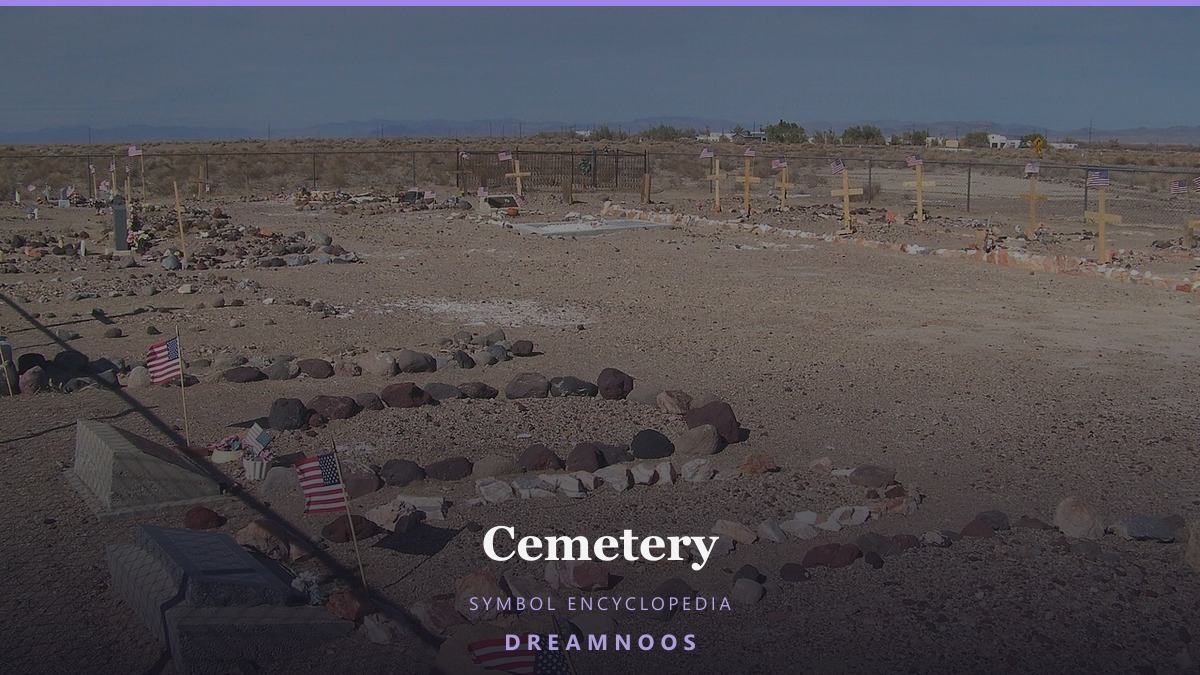
Cemetery
Cemetery symbolism in dreams — grief, ancestry, endings, memory, and what you bury but visit.
A cemetery is a place built for a contradiction: it exists to hold what has ended, and it exists to be visited. Burial concludes something, and then the grave is marked so that the conclusion can be returned to. That double function is why cemetery dreams so rarely read as simple endings. They tend to concern the relationship a dreamer maintains with what is already over.
This distinguishes the cemetery from the closely related symbol of death. Death dreams are usually about transition — the moment of change. Cemetery dreams are about aftermath: the period afterwards, the marker left behind, and what the dreamer does with it.
The three layers
Grief and continuing bonds. The most common reading and the most literal. Dreams of visiting a specific grave, tending it, or being unable to find it correspond closely to the actual work of mourning. Bereavement research treats an ongoing relationship with the person who died as the normal outcome of grief rather than evidence that it has stalled, and cemetery dreams are one of the places that relationship is maintained. Being unable to locate a grave — a frequently reported scenario — often accompanies a period when the dreamer feels they have lost their hold on the memory itself.
Ancestry and inheritance. Family plots, rows of shared surnames, and older graves shift the reading from a single loss to a lineage. These dreams tend to arise when the dreamer is confronting inherited material: family patterns repeating in their own life, obligations passed down, a resemblance to a parent noticed for the first time. The cemetery makes visible that the dreamer is one entry in a longer sequence.
Symbolic burial. The third layer concerns what the dreamer has laid to rest that was never a person — a career, an ambition, a version of themselves, a relationship. Dreams of burying an object, of an unmarked grave, or of a headstone bearing the dreamer’s own name belong here. The own-name grave is common enough to note explicitly: it is read as identity change rather than mortality, and it clusters around exactly the transitions where a person stops being who they were — leaving a profession, a marriage, a faith, a country.
The condition of the ground
One detail carries unusual interpretive weight in this symbol, and it is worth isolating. Whether the cemetery is tended or neglected — mown and cared for, or overgrown and forgotten — maps directly onto how the dreamer is relating to what is buried.
Overgrown graveyards tend to appear when something has been left unattended past the point the dreamer intended: a grief not given room, a family history not asked about while there was still someone to ask, a decision made and never revisited. Well-kept ones appear in the opposite condition, and sometimes carry their own signal — a dreamer maintaining a memorial with great care may be maintaining something that would be better allowed to weather.
The scenario of being buried alive belongs to a different reading altogether. It is not a grief dream. It is a constraint dream, and it sits closer to the vocabulary of suffocation and entrapment than to mourning — situations in which the dreamer feels finished off, written off, or held in a role that no longer contains them.
How to read a cemetery-coded dream
1. Is there a specific grave? A named stone points toward a particular relationship or a particular ending. A general graveyard points toward the dreamer’s relationship with endings as such.
2. Are you visiting, searching, or being buried? Three quite different positions — maintaining a bond, having lost hold of one, and being subject to an ending rather than surviving it.
3. Tended or overgrown? The state of the ground reports on the state of the attention.
4. Is it daylight? Cemetery dreams span the full range from peaceful daytime visits to horror-register night scenes, and the tonal difference usually separates grief work from fear.
5. Whose name is on the stone? Where the dreamer reads a name, it is almost always the interpretive centre of the dream — particularly when it is their own.
What this hub aggregates
The DreamNoos cemetery hub collects dream topics turning on graveyards, graves, headstones, burials, and funerals — including visiting the dead, digging, and the recurring own-grave scenario. For the closely related and frequently asked variant, see why dead person dreams.
Sideways, this hub points to family, where the ancestry layer concentrates, and to fear, where burial and confinement imagery lands. The death symbol covers the transition itself, and ghost the register in which the dead return rather than remain. The mother archetype is worth reading alongside dreams that turn on lineage.
Where cemetery dreams follow a recent bereavement and are causing sustained distress, that is worth raising with a grief counsellor. Symbolic reading sits alongside that kind of support rather than in place of it.
Cemeteries ask what the dreamer still waters with memory — and what might be allowed to rest.
Real-world reference: Cemetery on Wikipedia — for the literal, non-symbolic background on cemetery.
Explore Cemetery beyond dreams
This symbol hub covers dream interpretation. You can also explore cemetery through tarot, astrology, and angel numbers — reflective lenses, not competing truths.
Related tarot cards
Related zodiac signs
Angel numbers
Describe your dream in the interpreter — try keywords like cemetery graveyard grave tomb
Dreams featuring cemetery
- Big Cemetery in a Dream Big Cemetery dreams show cemetery appears at enlarged scale—symbol and transition under big, with witness, rescue, or release scenes.
- Black Cemetery in a Dream Black Cemetery dreams show cemetery appears in shadow tone—symbol and transition under black, with witness, rescue, or release scenes.
- Bleeding Cemetery in a Dream Bleeding Cemetery dreams show cemetery wounds in plain sight—symbol and transition under bleeding, with witness, rescue, or release scenes.
- Blue Cemetery in a Dream Blue Cemetery dreams show cemetery holds cool distance tone—symbol and transition under blue, with witness, rescue, or release scenes.
- Broken Cemetery in a Dream Broken Cemetery dreams show cemetery fractures without ending—symbol and transition under broken, with witness, rescue, or release scenes.
- Burning Cemetery in a Dream Burning Cemetery dreams show cemetery consumes in crisis—symbol and transition under burning, with witness, rescue, or release scenes.
- Crying Cemetery in a Dream Crying Cemetery dreams show cemetery grieves audibly—symbol and transition under crying, with witness, rescue, or release scenes.
- Dirty Cemetery in a Dream Dirty Cemetery dreams show cemetery shows soiled or stained layer—symbol and transition under dirty, with witness, rescue, or release scenes.
- Dying Cemetery in a Dream Dying Cemetery dreams show cemetery fades in process—symbol and transition under dying, with witness, rescue, or release scenes.
- Falling Cemetery in a Dream Falling Cemetery dreams show cemetery drops from height—symbol and transition under falling, with witness, rescue, or release scenes.
- Flying Cemetery in a Dream Flying Cemetery dreams show cemetery rises off the ground—symbol and transition under flying, with witness, rescue, or release scenes.
- Golden Cemetery in a Dream Golden Cemetery dreams show cemetery shines as valued ideal—symbol and transition under golden, with witness, rescue, or release scenes.
- Green Cemetery in a Dream Green Cemetery dreams show cemetery carries living growth tone—symbol and transition under green, with witness, rescue, or release scenes.
- Lost Cemetery in a Dream Lost Cemetery dreams show cemetery misplaced but may return—symbol and transition under lost, with witness, rescue, or release scenes.
- Pregnant Cemetery in a Dream Pregnant Cemetery dreams show cemetery swells before release—symbol and transition under pregnant, with witness, rescue, or release scenes.
- Red Cemetery in a Dream Red Cemetery dreams show cemetery shows urgent vivid tone—symbol and transition under red, with witness, rescue, or release scenes.
- Running Cemetery in a Dream Running Cemetery dreams show cemetery moves under pressure—symbol and transition under running, with witness, rescue, or release scenes.
- White Cemetery in a Dream White Cemetery dreams show cemetery appears in pale clarity—symbol and transition under white, with witness, rescue, or release scenes.
- Yellow Cemetery in a Dream Yellow Cemetery dreams show cemetery glows with bright caution—symbol and transition under yellow, with witness, rescue, or release scenes.
- Funeral in a Dream Funeral dreams stage the public marking of an ending — who attends, who is missing, and whether the dreamer is mourner or subject.
Share Your Dream Experience
Had a similar dream? Share your experience or ask a question — comments appear after moderation.
No comments yet. Be the first to share your experience.