
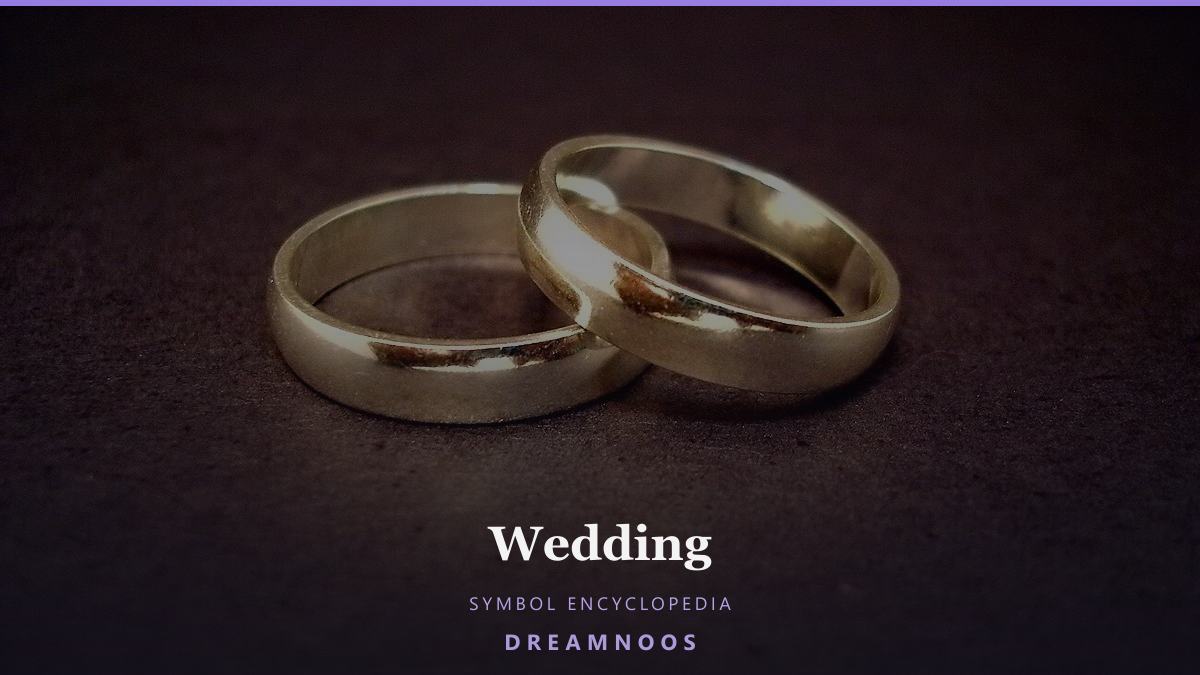
Wedding
Wedding symbolism in dreams — commitment, public vow, family pressure, merger, and fear of binding.
A wedding is the most heavily witnessed act most people ever perform. That is its defining feature symbolically — not the love, which can exist unannounced, but the public declaration of it in front of an assembled audience whose presence makes the commitment binding in a way a private one is not. Dream symbolism uses the whole apparatus: the vow, the witnesses, the family in rows, the irrevocability.
Because of that, wedding dreams reach well beyond romance. They appear around business partnerships, creative collaborations, religious commitments, career decisions, and any situation in which a person is about to bind themselves publicly to something. The dream borrows the ceremony because the ceremony is the clearest available image for a commitment that cannot quietly be undone.
The three layers
Union and integration. The favourable reading, and the one classical sources emphasise. A wedding that proceeds well can mark a genuine joining — of two people, of a project reaching its public phase, or in depth-psychological terms of parts of the self coming into agreement. Dreams in which the dreamer marries a stranger they nonetheless feel warmly toward frequently belong here: the figure represents a quality being taken on rather than a person.
Obligation and entrapment. The counter-reading, and the more commonly reported. Weddings that go wrong in dreams — the wrong partner at the altar, a ceremony the dreamer cannot stop, a dress that does not fit, guests who should not be there, an inability to speak the vow — correspond to commitments the dreamer feels bound to rather than chose. These arise around obligations of every kind, and notably often around actual weddings, where a dreamer’s ambivalence finds no other outlet.
Family script. The third layer concerns the audience. Weddings are lineage events: they are attended by families, they involve inherited ritual, and they are frequently the site where a couple’s private arrangement meets two families’ expectations. Dreams that foreground parents, cultural ceremony, or the crowd rather than the partner are usually concerned with that pressure — what the dreamer is expected to do, by whom, and what it would cost to refuse.
Common scenarios and what discriminates them
The absent partner. Standing at an altar with no one arriving is among the most frequently reported wedding dreams. It reads less as fear of abandonment than as commitment made without a clear object — a person prepared to bind themselves who does not know to what.
Marrying an ex. Common, distressing, and reliably misread. It rarely indicates a wish to return. The ex in dream vocabulary tends to represent a period of the dreamer’s own life rather than the actual person, and marrying one usually points at a quality, freedom, or version of the self associated with that era.
The wedding that cannot be stopped. Ceremonies that proceed while the dreamer tries to interrupt them belong to the entrapment reading in its sharpest form, and tend to accompany situations where a process has acquired momentum past the point the dreamer feels able to intervene.
Attending rather than marrying. Where the dreamer is a guest, the reading shifts toward witnessing others’ commitments — and often toward comparison, particularly during periods when peers are reaching life stages the dreamer has not.
How to read a wedding-coded dream
1. Are you marrying, attending, or officiating? Three quite different positions with respect to the commitment.
2. Who is the partner, and how do you feel about them? The identity matters less than the emotional register, which is usually unambiguous.
3. Does the ceremony complete? Interrupted, abandoned, and completed weddings read very differently.
4. Who is watching? The composition of the audience often locates the pressure the dream is actually about.
5. What is the dominant feeling? Wedding dreams span joy and dread more widely than almost any other symbol, and the tone is the most reliable single indicator.
What this hub aggregates
The DreamNoos wedding hub collects dream topics turning on marriage ceremonies, brides and grooms, altars, and vows — including disastrous weddings, absent partners, marrying an ex, and attending others’ ceremonies. For the most frequently asked variant, see why wedding dreams.
Sideways, this hub points to love and to family, the two themes that between them account for most wedding dreams. The ring symbol carries the object that survives the ceremony and is worth reading alongside; ex covers the frequently reported altar variant. In tarot, the Lovers supplies the closest parallel — though notably it concerns choice rather than ceremony, which is often the more useful frame.
Weddings ask what the dreamer is willing to sign in public, and what they still want to keep private.
Real-world reference: Wedding on Wikipedia — for the literal, non-symbolic background on wedding.
Explore Wedding beyond dreams
This symbol hub covers dream interpretation. You can also explore wedding through tarot, astrology, and angel numbers — reflective lenses, not competing truths.
Related tarot cards
Related zodiac signs
Angel numbers
Describe your dream in the interpreter — try keywords like wedding marriage bride groom
Dreams featuring wedding
- Dead Dress in a Dream Dead-dress dreams still the role you wear—feminine presentation lifeless, occasion gown gone gray, identity costume that no longer fits the woman you are becoming.
- Black Wedding in a Dream Black Wedding dreams show wedding appears in shadow tone—symbol and transition under black, with witness, rescue, or release scenes.
- Bleeding Wedding in a Dream Bleeding Wedding dreams show wedding wounds in plain sight—symbol and transition under bleeding, with witness, rescue, or release scenes.
- Crying Wedding in a Dream Crying Wedding dreams show wedding grieves audibly—symbol and transition under crying, with witness, rescue, or release scenes.
- Dirty Wedding in a Dream Dirty Wedding dreams show wedding shows soiled or stained layer—symbol and transition under dirty, with witness, rescue, or release scenes.
- Dying Wedding in a Dream Dying Wedding dreams show wedding fades in process—symbol and transition under dying, with witness, rescue, or release scenes.
- Falling Wedding in a Dream Falling Wedding dreams show wedding drops from height—symbol and transition under falling, with witness, rescue, or release scenes.
- Flying Wedding in a Dream Flying Wedding dreams show wedding rises off the ground—symbol and transition under flying, with witness, rescue, or release scenes.
- Golden Wedding in a Dream Golden Wedding dreams show wedding shines as valued ideal—symbol and transition under golden, with witness, rescue, or release scenes.
- Green Wedding in a Dream Green Wedding dreams show wedding carries living growth tone—symbol and transition under green, with witness, rescue, or release scenes.
- Lost Wedding in a Dream Lost Wedding dreams show wedding misplaced but may return—symbol and transition under lost, with witness, rescue, or release scenes.
- Pregnant Wedding in a Dream Pregnant Wedding dreams show wedding swells before release—symbol and transition under pregnant, with witness, rescue, or release scenes.
- Red Wedding in a Dream Red Wedding dreams show wedding shows urgent vivid tone—symbol and transition under red, with witness, rescue, or release scenes.
- White Wedding in a Dream White Wedding dreams show wedding appears in pale clarity—symbol and transition under white, with witness, rescue, or release scenes.
- Yellow Wedding in a Dream Yellow Wedding dreams show wedding glows with bright caution—symbol and transition under yellow, with witness, rescue, or release scenes.
- Wedding in a Dream A nuanced interpretation of wedding dreams, including commitment, social expectation, transition anxiety, and symbolic union dynamics.
Share Your Dream Experience
Had a similar dream? Share your experience or ask a question — comments appear after moderation.
No comments yet. Be the first to share your experience.