The Hidden Engineering of Car Tires: Why the Smallest Contact Patch Matters
The Hidden Engineering of Car Tires: Why the Smallest Contact Patch Matters
A modern car can contain hundreds of sensors, sophisticated driver-assistance systems, powerful computers and carefully calibrated suspension components. Yet almost every movement the vehicle makes depends on four relatively small areas of rubber touching the road.
Those contact patches determine how effectively a car accelerates, turns, brakes and transfers energy to the surface beneath it. They also influence cabin noise, electricity consumption, fuel efficiency and ride comfort.
Tires are often treated as ordinary replacement parts, chosen mainly by size, price or brand. In reality, they are among the most carefully engineered components in a vehicle. Their performance depends on a complicated relationship between rubber chemistry, internal construction, tread geometry, temperature, air pressure and road conditions.
Understanding that relationship reveals something important about automotive engineering: improving a vehicle does not always mean adding more technology. Sometimes, the most significant improvements begin where the car meets the road.
The Contact Patch: A Small Area With an Enormous Responsibility
A tire does not touch the road across its entire circumference. Only a relatively small section of its tread is in contact with the surface at any particular moment.
This area is known as the contact patch.
Its size and shape change with several factors, including vehicle weight, tire pressure, construction and driving conditions. The rubber deforms as the wheel rotates, allowing the tread to maintain contact with an uneven road.
This deformation is essential. A perfectly rigid wheel would struggle to maintain consistent contact with irregular surfaces, transferring more impact and vibration into the vehicle.
A tire must therefore perform several jobs simultaneously:
- Support the vehicle’s weight.
- Generate the friction required for acceleration and braking.
- Provide lateral grip during cornering.
- Absorb some road irregularities.
- Maintain stability across changing temperatures and surfaces.
- Resist excessive energy loss as it repeatedly deforms.
These requirements can conflict. A tire designed to prioritize comfort may behave differently from one optimized for precise steering or maximum wet-road grip.
The engineering challenge is not to maximize one characteristic in isolation. It is to find a suitable balance for the vehicle and its intended use.
Why Tire Rubber Is More Than Ordinary Rubber
The material covering a tire may look simple, but its composition is the result of extensive materials engineering.
Modern tire compounds typically combine natural and synthetic rubber with reinforcing materials, oils, processing ingredients and chemical additives. Carbon black and silica are among the materials used to influence strength, wear characteristics and grip.
The precise formulation depends on the intended application.
A performance tire may prioritize steering response and grip under demanding conditions. A touring tire may emphasize comfort, durability and predictable behavior. A winter tire needs a compound and tread design capable of maintaining useful flexibility and traction in cold conditions.
Temperature is particularly important.
Rubber does not behave identically at every temperature. Its flexibility and response change as conditions become colder or warmer. This is one reason why tire categories exist.
Summer tires are developed for warmer operating conditions. Winter tires are designed to maintain useful performance in cold weather and on snow-covered surfaces. All-season tires attempt to provide a broader compromise across different conditions.
No single tire is automatically ideal for every climate, vehicle or driving style.
The Hidden Work of Tread Patterns
The grooves and channels on a tire are not decorative features. They help manage the interaction between rubber, water, snow and road surfaces.
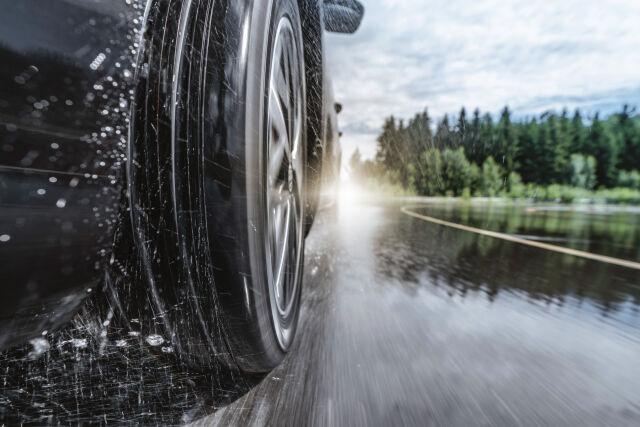
On wet roads, water can form a layer between the tire and the pavement. If the tire cannot sufficiently displace that water, its ability to maintain contact with the road can decline.
Tread grooves provide pathways that help move water away from the contact area.
This is one reason tread design matters so much in wet-weather performance. The depth, direction and arrangement of grooves influence how a tire behaves as it encounters water.
Different tread patterns also affect noise and stability.
Some designs use variations in block size and spacing to reduce repetitive sound frequencies. Others prioritize directional water evacuation or specific handling characteristics.
There is no universally superior tread pattern. Each design reflects a set of engineering compromises.
Tread wear gradually changes those characteristics. As grooves become shallower, the tire has less capacity to manage water. A tire that performed adequately when new may therefore behave differently after years of use.
The visible appearance of a tire does not always tell the entire story, either. Cracks, bulges, damage and irregular wear can indicate problems that require professional inspection.
Rolling Resistance: The Energy Lost With Every Rotation
One of the most important but least visible characteristics of a tire is rolling resistance.
As a tire rotates, its structure continuously deforms under the vehicle’s weight. Some of the energy used to deform the rubber is not returned to the vehicle. Instead, it is dissipated as heat.
That energy loss contributes to rolling resistance.
A tire with lower rolling resistance requires less energy to maintain movement under comparable conditions. For a conventional vehicle, this can influence fuel consumption. For an electric vehicle, it can affect the amount of electricity needed to travel a given distance.
The European Commission’s report published on June 24, 2026, provides a useful indication of how significant this engineering challenge remains.
The Commission estimates that replacing high-rolling-resistance tires with lower-resistance alternatives could reduce average passenger-car energy consumption by approximately 2%.
The report also found that the average rolling resistance of new passenger-car tire models introduced since 2021 had improved by an estimated 5.1% compared with a business-as-usual scenario.
These figures describe different measurements: one concerns potential vehicle energy savings from changing tires, while the other concerns estimated improvements in the rolling resistance of new tire models. Neither should be interpreted as a guaranteed result for every driver.
For electric vehicles, reducing rolling resistance can help lower energy consumption and potentially extend driving range. The actual benefit depends on vehicle design, speed, temperature, road surface and driving conditions.
The Efficiency and Safety Trade-Off
Reducing rolling resistance sounds like an obvious goal. Less wasted energy means lower fuel consumption or electricity use.
But tire performance cannot be judged by energy efficiency alone.
Wet grip is equally important because it influences how effectively a tire can transmit braking forces on a wet surface.
The European Commission identifies rolling resistance and wet grip as interrelated performance characteristics. Improvements in one area can affect other properties, creating trade-offs that manufacturers must manage.
This is why the European Union’s tire label presents several separate performance indicators rather than reducing tire quality to a single score.
The label provides information about:
- Rolling resistance: An indicator of energy efficiency.
- Wet grip: An indicator of braking performance on wet roads.
- External rolling noise: A measure of noise generated as the tire moves across the road.
- Snow and ice suitability: Additional symbols identify tires approved for relevant severe winter conditions.
The label helps consumers compare products, but it does not describe every aspect of tire performance. Handling, durability, comfort, high-speed behavior and performance in specific climates require additional information.
A tire with a strong efficiency rating is not automatically the safest choice for every driver. Equally, a tire that performs well in one test category may have different characteristics in another.
The better approach is to consider the complete set of requirements for the vehicle and its operating environment.
Why Electric Vehicles Put New Demands on Tires
Electric vehicles have made tire selection more complicated.
Their electric motors can deliver substantial torque very quickly, creating different demands during acceleration. Many electric vehicles are also relatively heavy because of their battery packs.
These characteristics influence tire design.
Manufacturers may develop tires specifically for electric vehicles, focusing on a combination of load capacity, rolling resistance, noise management and grip.
Noise is particularly noticeable in electric cars. Without the familiar sound of an internal combustion engine, road and tire noise can become more prominent inside the cabin.
A tire that produces noticeable sound in a conventional car may therefore be perceived differently in an electric vehicle.
Range is another consideration. Rolling resistance affects how much energy the vehicle needs to overcome tire deformation during travel.
However, an EV-specific label or marketing description should not be treated as proof that a tire is suitable for every electric car. Correct dimensions, load rating, speed rating and manufacturer approval remain essential.
The same principle applies to conventional vehicles: a tire must be appropriate for the vehicle, not simply for a broad category such as SUV, sedan or electric car.
Tire Pressure: The Engineering Variable Drivers Can Actually Control
Among all the factors affecting tire performance, inflation pressure is one of the most important that drivers can monitor directly.
Pressure affects how the tire deforms and how its tread interacts with the road.
Underinflation can increase deformation, heat generation and rolling resistance. It can also contribute to irregular wear and reduce predictable handling.
Overinflation can change the contact pattern and make the ride harsher. It may also increase susceptibility to certain types of road damage and produce uneven wear.
The correct pressure is not necessarily the maximum pressure printed on the tire.
Drivers should follow the vehicle manufacturer’s recommended cold inflation pressure, usually shown on a label inside the driver’s door area or in the owner’s manual. Some vehicles specify different pressures for front and rear tires or for different loading conditions.
The US National Highway Traffic Safety Administration recommends checking tire pressure at least once a month when tires are cold. It also emphasizes that tire-pressure monitoring systems do not replace regular inspection.
A monitoring system is useful because it can warn drivers about significant pressure loss. But it is not a substitute for checking all tires with an appropriate pressure gauge.
This is a simple maintenance task with consequences that extend far beyond tire longevity.
Why Tire Age Matters Even When the Tread Looks Good
Tire wear is visible, but aging is more complicated.
Rubber and other tire components change over time as a result of environmental exposure, temperature, storage conditions and use. A tire that has traveled relatively few miles is not necessarily in perfect condition.
Sunlight, heat, poor storage and long periods without use can contribute to deterioration.
The NHTSA warns that tire aging can create risks even when tread wear is not the main concern. It recommends inspecting tires for damage and paying attention to changes in performance, including vibration, noise and pressure loss.
Drivers should also understand the manufacturing date printed in the tire identification code. The final four digits of the relevant date code indicate the week and year of manufacture.
There is no single replacement interval that applies to every tire regardless of manufacturer, vehicle and storage history. Drivers should follow the vehicle and tire manufacturer’s guidance and seek professional inspection when there are signs of deterioration.
The broader lesson is that tire condition cannot be judged by tread depth alone.
The Future of Tire Engineering
Tire development is increasingly connected to wider changes in the automotive industry.
Electric vehicles create demand for lower energy losses and improved noise control. Environmental regulation encourages manufacturers to consider efficiency, material use and product performance. Advances in materials science may also create opportunities for compounds with different durability and performance characteristics.
The European Commission’s 2026 review of tyre labelling reflects this changing environment. It examines consumer understanding, market developments, enforcement and the reliability of information provided through the labelling system.
The report also discusses the potential inclusion of additional information about tire abrasion and mileage. These issues matter because tire wear has implications beyond the individual vehicle, including material consumption and the release of particles from road use.
Future developments may also involve improved sensing and monitoring. Connected vehicle systems could provide drivers with more detailed information about tire pressure, temperature and wear. However, monitoring technology cannot eliminate the need for sound tire construction, appropriate selection and physical inspection.
The tire will remain a mechanical component operating under changing loads, temperatures and road conditions. Digital systems can help monitor it, but they cannot remove the underlying engineering challenge.
The Most Important Automotive Technology May Be the Least Visible
Tires rarely receive the same attention as engines, batteries, autonomous driving systems or vehicle software.
Yet every braking maneuver, every corner and every kilometer of travel depends on their ability to maintain contact with the road.
Their performance is the result of several disciplines working together: materials science, mechanical engineering, fluid dynamics, thermodynamics and vehicle dynamics.
The next time a car moves through heavy rain or travels quietly along a highway, much of the work happens out of sight.
A tire is not simply a piece of rubber attached to a wheel. It is a carefully engineered interface between a moving machine and an unpredictable surface.
And in automotive engineering, that interface can make the difference between efficiency, comfort and control.
Sources and Further Reading
-
European Commission. (2026). Report on the implementation of Regulation (EU) 2020/740 on the labelling of tyres with respect to fuel efficiency and other parameters. COM(2026) 326 final. https://eur-lex.europa.eu/legal-content/EN/TXT/?uri=celex:52026DC0326
-
European Commission. Tyres " Energy Efficient Products. https://energy-efficient-products.ec.europa.eu/product-list/tyres_en
-
National Highway Traffic Safety Administration. TireWise: Tire Safety and Maintenance. https://www.nhtsa.gov/vehicle-safety/tires
-
United States Tire Manufacturers Association. Tire Facts and Tire Service Life. https://www.ustires.org/tires-101/tire-facts
Image Information
Hero image: hidden-engineering-car-tires-contact-patch.jpg
Format: JPEG
Dimensions: 1200 × 675 px
Aspect ratio: 16:9
Alt text: Close-up of a modern car tire gripping a wet asphalt road, showing its tread pattern and contact with the surface.