Research source: Vertical Characteristics of Marine Heatwaves in Global Coral Reef Regions " Geophysical Research Letters, DOI: 10.1029/2026GL123865
Keywords: ocean, climate, coral reef, marine heatwave, mesophotic, deep reef, conservation
Sources:
- Vertical Characteristics of Marine Heatwaves in Global Coral Reef Regions " Geophysical Research Letters
- NOAA " What Are Mesophotic Coral Ecosystems?
- Climate change impacts on mesophotic regions of the Great Barrier Reef
Deep Coral Reefs Are Not Safe From Marine Heatwaves, Study Finds
Scientists have found that extreme ocean warming can extend far below the surface, putting deeper coral ecosystems at risk and challenging the idea that depth alone can provide protection from climate change.
For years, deeper coral reefs have offered scientists a reason for cautious optimism.
While shallow reefs are increasingly exposed to marine heatwaves, bleaching and other environmental pressures, coral communities farther below the surface were thought to have an important advantage. Cooler water and reduced exposure to sunlight could help them escape the worst effects of extreme surface temperatures.
These deeper ecosystems, known as mesophotic coral ecosystems, have therefore attracted attention as possible refuges for marine life and potential sources of recovery for damaged shallow reefs.
But a study published on November 10, 2026, in Geophysical Research Letters raises a significant question about that assumption.
By analysing more than three decades of ocean data, researchers found that marine heatwaves can extend deep into coral reef environments, sometimes reaching depths of 150 metres. Although such events become less frequent with depth, their accumulated intensity can be greater below the surface.
The findings suggest that some of the ocean’s less visible coral habitats may be more exposed to extreme warming than scientists previously understood.
The hidden world beneath shallow coral reefs
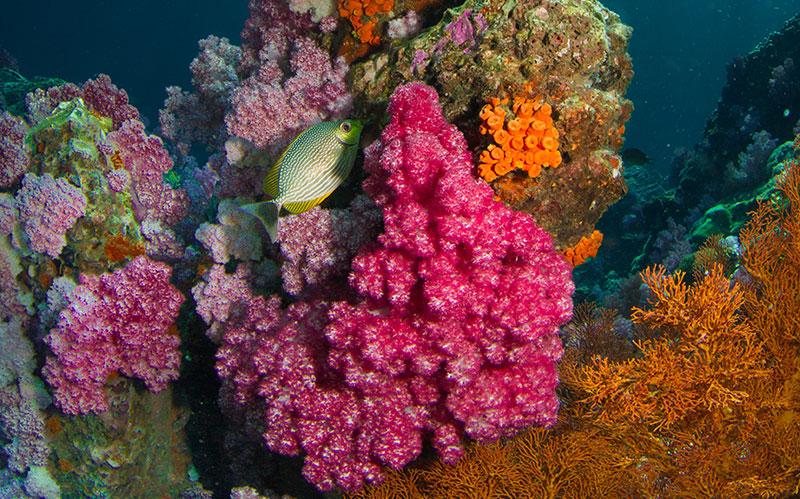
Most people picture coral reefs as brightly coloured underwater landscapes filled with tropical fish, clear water and sunlight.
Yet coral ecosystems do not end where sunlight becomes weaker.
Mesophotic reefs generally occupy the dimly lit zone between approximately 30 and 150 metres below the surface. The word mesophotic combines the Greek words for middle and light, reflecting the limited sunlight available at these depths.
These ecosystems can support corals, sponges, algae and a variety of fish. Some species are closely related to those found on shallow reefs, while others are adapted to the distinctive conditions of deeper water.
Their ecological importance goes beyond providing another habitat.
In some locations, deeper reefs may help replenish damaged shallow ecosystems by supplying larvae or other biological resources. They can also provide feeding, breeding and sheltering grounds for marine species.
The National Oceanic and Atmospheric Administration (NOAA) has identified mesophotic ecosystems as important habitats that may, under certain conditions, support the recovery of shallower coral communities.
That possibility has made deeper reefs an increasingly important subject for conservation research.
However, being deeper does not necessarily mean being protected from climate-related stress.
What the new research discovered
The research, titled Vertical Characteristics of Marine Heatwaves in Global Coral Reef Regions, was published in November 2026.
The study examined global patterns of marine heatwaves across coral reef regions using two high-resolution ocean reanalysis datasets covering the period from 1993 to 2023.
Researchers investigated temperature conditions at seven depth ranges, from the surface down to 150 metres.
Their analysis revealed a pattern that deserves attention: the number of marine heatwave days generally decreases with depth, but the cumulative intensity of these events can increase.
In other words, deeper waters may experience fewer extreme warming days, yet the heatwaves that do occur can produce substantial accumulated thermal stress.
During major climate anomalies, including strong El Niño events and the unusual three-year La Niña period from 2020 to 2023, severe marine heatwaves frequently extended to depths of 150 metres.
At depths of 90 to 150 metres, cumulative intensity reached as much as 160°C-days in the study’s analysis.
This figure is an accumulated temperature-anomaly measure, not an indication that seawater itself reached 160°C. It reflects the combined intensity of temperature departures over time.
The researchers also found that more than half of the global reef regions examined experienced significant heatwave exposure within the upper 70 metres during the analysed extreme periods.
The results indicate that marine heatwaves cannot be understood through surface temperature measurements alone.
Why deeper water is not always a safe refuge
The idea of deep reefs as climate refuges is based on a reasonable physical observation: water temperatures often decline with depth, and deeper habitats can be less exposed to rapid surface warming.
But ocean temperature is not distributed in a simple, permanent vertical pattern.
Currents, mixing, seasonal conditions and large-scale climate events can influence how heat moves through the water column. During some events, unusual temperature conditions can reach considerably deeper than expected.
El Niño and La Niña are particularly important in this context.
These large-scale climate patterns influence ocean temperatures, atmospheric circulation and weather conditions across different parts of the world. Their effects can extend far beyond the surface layer.
The 2020"2023 triple-dip La Niña period was one of the major climate anomalies examined in the study. The researchers found that severe subsurface marine heatwaves during such events could affect coral habitats well below the depths normally associated with surface warming.
This does not mean that every deep reef experiences the same conditions. Local oceanography, reef structure and species composition all influence how ecosystems respond.
It does, however, challenge the assumption that deeper coral habitats are automatically protected from marine heatwaves.
Why marine heatwaves matter to coral life
Corals are living animals that depend on a close relationship with microscopic algae living inside their tissues.
These algae, commonly known as zooxanthellae, provide much of the energy corals need through photosynthesis. In return, the coral offers the algae a protected environment and access to nutrients.
When water temperatures remain unusually high, this relationship can break down.
Stressed corals may expel their symbiotic algae, losing much of their colour and becoming visibly pale. This process is known as coral bleaching.
Bleached corals are not necessarily dead. If temperatures return to suitable levels quickly enough, some can recover. But prolonged or repeated heat stress can leave them vulnerable to disease, starvation and mortality.
Marine heatwaves are particularly concerning because their effects depend not only on how hot the water becomes, but also on how long the abnormal conditions persist.
For deeper reefs, the new study highlights another complication: a habitat that experiences fewer heatwave days may still face substantial cumulative thermal stress when extreme events occur.
That distinction matters when conservation plans are designed around assumptions about which depths offer the greatest protection.
A warning about relying on surface measurements
One of the most important implications of the research concerns how scientists monitor the ocean.
Satellite observations have transformed the study of marine heatwaves by providing extensive information about sea surface temperatures. These measurements are valuable, but they cannot independently describe the full thermal conditions experienced by organisms living tens or hundreds of metres below the surface.
A reef at 100 metres may experience a different temperature history from the water directly above it.
If conservation assessments rely too heavily on surface measurements, they may underestimate the thermal exposure of deeper coral habitats.
The researchers used two ocean reanalysis products to reconstruct temperature conditions throughout the water column. Such datasets combine observations with ocean models to provide a more complete picture of changing conditions.
This approach makes it possible to investigate areas where continuous direct measurements are difficult to obtain.
However, reanalysis is not the same as having temperature sensors installed at every reef. The findings are based on modelled ocean conditions and should be interpreted alongside future field measurements.
More underwater monitoring will be needed to determine how specific coral species respond to these deep-water heatwaves.
What this means for coral reef conservation
The findings do not make deeper reefs unimportant. Quite the opposite: they strengthen the case for understanding and protecting them as distinct ecosystems.
Some mesophotic reefs may still provide valuable refuges under particular local conditions. Others may be exposed to substantial heat stress during extreme climate events.
Conservation strategies therefore need to account for differences between regions, depths and species rather than treating all deeper reefs as equally protected.
Marine protected areas may also need to consider the vertical structure of ocean ecosystems. Protecting a reef only through its shallow-water habitat could overlook important communities living farther below the surface.
Future research could help identify which deeper locations retain relatively stable temperatures, which are exposed to recurring heatwaves and which habitats have the greatest potential to support ecosystem recovery.
The study also reinforces the need for more comprehensive ocean monitoring, combining satellite observations, underwater sensors, research vessels and improved modelling.
The ocean’s deeper ecosystems deserve closer attention
Coral reefs are often discussed as if the greatest threats exist only in the sunlit waters close to the surface.
The latest research offers a more complicated picture.
Deep coral habitats may experience fewer marine heatwave days, but extreme events can still penetrate far below the surface and generate substantial accumulated thermal stress.
That does not mean every deep reef is doomed, nor does it eliminate their potential role in supporting damaged shallow ecosystems. It means their resilience cannot be assumed simply because they are deeper.
As ocean temperatures continue to change, scientists will need a more complete understanding of what happens throughout the water column.
Some of the most important signs of climate stress may be developing in places that satellites cannot see directly and divers cannot easily reach.
The future of coral reef conservation may depend not only on protecting the colourful landscapes visible near the surface, but also on understanding the quieter ecosystems hidden much farther below.