Beavers: The Wild Engineers Rebuilding Wetlands and Reshaping Rivers
Discover how beavers reshape rivers, restore wetlands, support biodiversity and influence water storage, drought and wildfire resilience.
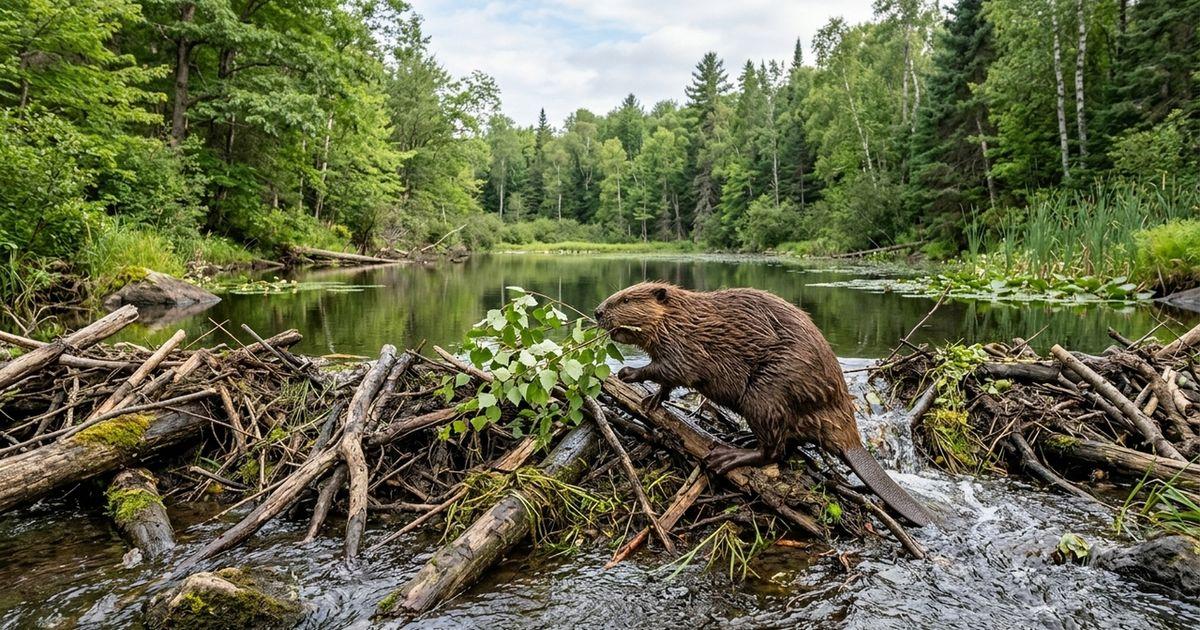
Beavers: The Wild Engineers Rebuilding Wetlands and Reshaping Rivers
A fallen tree across a stream might look like little more than a temporary obstacle. But when a beaver begins collecting branches, mud and vegetation around it, that small obstruction can become the starting point of a much larger environmental transformation.
Water slows. Sediment accumulates. Shallow pools develop, and plants begin colonizing newly flooded ground. Over time, a narrow stream can become a complex wetland supporting fish, amphibians, insects, birds and mammals.
The animal responsible is not a landscape architect or an environmental engineer. It is a beaver.
For centuries, beavers were primarily valued or feared for their fur, their impact on trees and the changes they made to waterways. Today, ecologists increasingly study them for another reason: their ability to modify entire ecosystems through ordinary building behavior.
Research published in 2025 and 2026 has added new evidence about how beaver activity can influence water storage, peatland hydrology, vegetation and landscape resilience. The findings are attracting attention from conservationists and restoration specialists interested in working with natural processes rather than relying exclusively on engineered infrastructure.
Yet beavers are not a universal solution to environmental problems. Their benefits depend on geography, water conditions, surrounding ecosystems and how people manage the landscapes they inhabit.
Understanding what these animals actually do reveals why a small mammal can have such a substantial influence on the natural world.
How a Beaver Turns a Stream Into a Wetland
Beavers belong to the genus Castor. The two living species are the North American beaver (Castor canadensis) and the Eurasian beaver (Castor fiber).
Both are adapted to life around freshwater environments. Their strong incisors allow them to cut woody vegetation, while their powerful bodies and broad tails help them move through water.
Their most recognizable construction is the dam.
A beaver typically begins by using available branches, logs, stones and mud to obstruct flowing water. The structure does not need to be perfectly symmetrical or architecturally precise. It only needs to slow the stream sufficiently to create a more suitable water level.
As water collects behind the dam, the surrounding environment begins to change.
Sediment carried by the stream can settle in slower-moving water. Flooded areas expand, and plants adapted to wet conditions may establish themselves along the new margins. The resulting habitat can contain open water, shallow pools, muddy banks, submerged vegetation and patches of wet woodland.
Some beavers also construct canals to move wood and other materials through their territories. These channels can connect different parts of a wetland and alter how water moves across the landscape.
The result is not simply a pond. It is a changing network of habitats.
Ecologists describe animals capable of physically modifying their environments in this way as ecosystem engineers.
Beavers are among the clearest examples because their activities can alter local hydrology, sediment movement, vegetation and the distribution of other species.
Why Wetlands Created by Beavers Matter to Wildlife
A stream with a relatively uniform channel offers a different range of habitats from a wetland containing pools, side channels, shallow water and flooded vegetation.
Beaver activity can increase this variety.
Different species use different parts of the resulting environment. Amphibians may benefit from shallow, slower-moving water. Aquatic insects can occupy submerged vegetation and sediment-rich habitats. Waterbirds may find feeding opportunities in shallow pools, while mammals can use dense vegetation and sheltered banks.
The effects are not necessarily limited to the water itself.
A 2024 study published in Science of the Total Environment found that bird richness and abundance were associated with beaver-modified sites in temperate forests. The researchers reported that the influence extended into nearby terrestrial habitats, with changes observed up to 100 meters from beaver sites.
This suggests that the ecological effects of beavers can spread beyond the boundaries of the ponds they create.
However, greater habitat complexity does not automatically benefit every species.
Some organisms depend on fast-flowing, cold and well-oxygenated water. When a stream becomes slower or warmer, their habitat may become less suitable. Other species may benefit from the same changes.
The ecological outcome therefore depends on the original habitat and the species being considered.
The important point is that beavers create environmental variation. They do not simply make every ecosystem better in every possible way.
Water Storage: Why Scientists Are Looking at Beaver Dams Again
One of the most interesting aspects of beaver engineering is its influence on how water moves through a landscape.
A fast-moving stream transports water downstream relatively quickly. When dams interrupt that movement, water can spread into adjacent areas, accumulate in ponds and interact with surrounding soils.
This can increase the amount of water stored within a river corridor and change how long water remains in a particular location.
The effect is especially interesting in landscapes exposed to prolonged dry periods.
Wetland soils and saturated vegetation can retain moisture that would otherwise be absent from the surrounding environment. In some locations, these conditions may help maintain refuges for wildlife during drought and heat.
A major review published in 2024 in Annual Review of Ecology, Evolution, and Systematics examined how beavers influence local hydroclimatic conditions and how their wetlands may contribute to ecosystem resilience under a changing climate.
The review also emphasized that the effects vary according to landscape characteristics, climate and ecological context.
Water storage is not the same as creating new water. Beavers redistribute and temporarily retain water within a catchment. The wider consequences depend on rainfall, groundwater connections, soil properties and downstream flows.
This distinction matters when evaluating claims that beaver restoration can solve water shortages.
It cannot replace responsible water management, but it can contribute to natural processes that influence how water is retained and released.
Can Beavers Help Reduce Wildfire Risk?
The relationship between beavers and wildfire resilience has become an increasingly important research topic.
In dry landscapes, riparian vegetation surrounding streams and wetlands can provide areas where plants retain more moisture than vegetation farther from water.
Beaver dams can expand these moist areas by slowing water movement and increasing local water storage. Under suitable conditions, the resulting wetland vegetation may remain greener during dry periods.
This can create habitat refuges and potentially reduce the continuity of dry vegetation that helps fires spread.
A 2025 study published in Ecological Applications examined the potential benefits of restoring beavers in California’s Sierra Nevada.
The researchers modeled historical dam-building capacity, potential water storage and possible fire-resilience benefits. Their conservative estimates suggested that remaining beaver dam capacity in the region could support approximately 120 million cubic meters of additional surface-water storage and create around 2,200 square kilometers of potential fire-resilience areas in high-risk locations.
These are modeled estimates of potential benefits, not measurements of water already stored or proof that beavers prevent wildfires.
The distinction is important.
Fire behavior depends on many interacting factors, including wind, temperature, fuel moisture, vegetation structure and terrain. Beaver wetlands may influence some local conditions, but they cannot eliminate wildfire risk.
Their value lies in potentially strengthening certain parts of a landscape, not replacing broader fire management.
New Research in 2026: What Happens When Beavers Return to Wetlands?
Research published in 2026 has provided additional evidence about the hydrological consequences of beaver restoration.
A study published in Ecohydrology on June 7, 2026, examined a five-year beaver reintroduction trial in North Yorkshire, England.
The project followed the effects of Eurasian beavers introduced into a monitored enclosure in 2019. Researchers combined ecological surveys, repeat photography, mobile LiDAR, environmental DNA sampling and hydrological modeling.
During the monitoring period, the beavers constructed six dams.
The researchers reported that the hydrological response became less variable, with lower peak flows than during the pre-beaver period.
This is an important finding because it shows how animal behavior can interact with existing natural flood-management measures.
However, a monitored trial in one landscape cannot establish that the same results will occur in every river system. Catchment size, rainfall, geology, vegetation and dam placement all influence the outcome.
Another study published in September 2026 examined beaver reintroduction in internationally important peatlands in England.
The researchers investigated how dams influenced surface-water and groundwater interactions, including the stability of water tables over a four-year monitoring period.
Peatlands are particularly important because their water conditions influence vegetation, carbon storage and the preservation of accumulated organic material.
The study adds to the evidence that beavers can influence more than visible surface water. Their engineering can also affect the relationship between streams, groundwater and surrounding wetland soils.
Together, these studies show why restoration projects increasingly rely on long-term monitoring rather than assuming that the presence of beavers automatically produces a predictable result.
The Complicated Side of Beaver Restoration
Beaver dams can create valuable habitats, but their effects are not always welcome.
When water levels rise, agricultural land, roads, drainage systems and other infrastructure may be affected. Trees can be damaged, culverts may become obstructed, and some landowners may experience flooding or changes in land use.
These conflicts can become particularly difficult where human settlements and agricultural activities occupy narrow river valleys.
There are also ecological trade-offs.
In certain environments, increased ponding may raise water temperatures or change the habitat available to species that depend on fast-flowing streams. Sediment can accumulate in some locations, while other areas experience different patterns of erosion and deposition.
A beaver dam can also be temporary. It may be repaired, expanded, breached or abandoned as water conditions and the animals’ behavior change.
This makes beaver restoration a long-term management challenge rather than a simple wildlife release project.
Successful programs generally require careful site assessment, monitoring, communication with local communities and practical measures to reduce conflicts.
Tools such as flow devices, protective barriers and modified culvert designs can sometimes help manage water levels or protect infrastructure without removing the animals entirely.
The goal is not to prevent beavers from changing their environment. Their ecological value comes precisely from that ability. The challenge is to identify locations where those changes are compatible with human needs.
Beaver Dams and the Future of Nature-Based Restoration
Traditional river engineering often focuses on controlling water through channels, barriers and drainage systems.
These structures can serve essential purposes, but they may also simplify river environments and separate waterways from their natural floodplains.
Nature-based restoration takes a different approach.
Instead of trying to control every movement of water, it aims to recover ecological processes that help landscapes function.
Beavers fit naturally into this approach because they build structures that alter water movement while creating habitat.
In locations where beavers once lived but were removed, restoring populations may help re-establish processes that disappeared along with the animals.
Where natural recolonization is not possible or suitable, conservationists sometimes use beaver dam analogues: human-built structures designed to imitate certain functions of beaver dams.
These structures can slow water, encourage sediment deposition and support riparian restoration. However, they are not identical to living beaver systems, which continue to change through animal activity.
Restoration specialists must also consider whether a particular landscape can support a stable beaver population and whether the expected ecological benefits justify the potential management costs.
A useful restoration project is not defined simply by the number of dams built. It is defined by whether the wider ecosystem becomes more functional and resilient over time.
A Small Animal With a Landscape-Sized Influence
Beavers demonstrate that environmental change does not always begin with large infrastructure or complex technology.
Sometimes it begins with a tree, a stream and an animal collecting branches.
By slowing water, creating ponds and changing vegetation patterns, beavers can reshape the physical structure of freshwater ecosystems. Their activities can influence wildlife communities, water storage and the resilience of some landscapes to environmental stress.
Recent research has strengthened the scientific case for considering beavers in restoration planning, while also revealing why local conditions and long-term monitoring remain essential.
They are not a universal answer to drought, flooding or wildfire. Nor are their dams automatically beneficial to every species or community.
But they offer a compelling example of what happens when wildlife is allowed to perform ecological functions that natural systems evolved around.
In a world where freshwater habitats are under increasing pressure, the beaver’s most important contribution may be its ability to make a stream more than just a channel carrying water downstream.
It can turn that stream into a living, changing landscape.
Sources and Further Reading
-
Moravek, J. A. et al. (2025). “Maximizing the Potential Benefits of Beaver Restoration for Fire Resilience and Water Storage.” Ecological Applications, 35(7), e70102. https://doi.org/10.1002/eap.70102
-
Fairfax, E. & Westbrook, C. (2024). “The Ecology and Evolution of Beavers: Ecosystem Engineers That Ameliorate Climate Change.” Annual Review of Ecology, Evolution, and Systematics, 55, 323"345. https://doi.org/10.1146/annurev-ecolsys-102722-122317
-
“Whole System Ecohydrological Change Following Natural Flood Management and a Five-Year Beaver Reintroduction Trial.” Ecohydrology, first published June 7, 2026. https://doi.org/10.1002/eco.70238
-
“Natural Drought Mitigation: Hydrological Impacts of Beavers in Internationally Important Peatlands.” Hydrological Processes, first published September 2026. https://doi.org/10.1002/hyp.70690
-
“Ecosystem Engineers Cause Biodiversity Spill-Over: Beavers Are Associated With Breeding Bird Assemblages on Both Wetlands and Adjacent Terrestrial Habitats.” Science of the Total Environment, 950, 175166 (2024). https://doi.org/10.1016/j.scitotenv.2024.175166
Editorial Image Information
Hero image: beavers-wild-engineers-wetlands-rivers.jpg
Alt text: A brown beaver beside a branch-built dam in a green woodland wetland, with water flowing through the structure.
Image dimensions: 1200 × 675 pixels.
Format: JPEG.